
Trigonometry Calculator: Solve Sin, Cos, Tan Problems Online
The first time trigonometry made sense to me, I was looking at the water tank on our roof. I knew my distance and the angle, but not the height. That evening I opened a trigonometry calculator online and got the height in seconds.
What Is a Trigonometry Calculator?
It finds sine, cosine and tangent, and solves right triangles. Give it an angle or a couple of side lengths, and it gives the answer with the working. A trig calculator does the same job as the trig keys on a scientific calculator, but it shows each step.
How a Trigonometry Calculator Works?
It works on ratios. In a right triangle, each angle has fixed side ratios: sine, cosine and tangent. Type in 30 degrees, ask for sine, and it returns 0.5, because the sine of 30 degrees is always 0.5. It can also run backwards: give it a ratio and it returns the angle, using arcsin, arccos or arctan.
What Types of Trigonometry Problems Can It Solve?
It solves four kinds of problems: sin, cos and tan values, a missing side from an angle and one side, a missing angle from two sides, and angle conversions and identities. It also finds reciprocal values: cosecant, secant and cotangent, which are 1 over sine, cosine and tangent.
How to Use the Trigonometry Calculator?
It takes less than a minute once you know the three moves below. I follow the same order every time, because skipping a step is how wrong answers happen.
Enter an Angle or Trigonometric Value
Start with what you know: type the angle in degrees, such as 30, or a ratio, such as sin equals 0.5, and the calculator works backwards to the angle. Check the unit first: 30 radians is not 30 degrees.
Select a Trigonometric Function
Pick sin, cos or tan by the sides you know: sine uses the opposite and the hypotenuse, cosine the adjacent and the hypotenuse, tangent the opposite and the adjacent. A trigonometry calculator sin cos tan shows all three values for one angle at once, which helps when you are unsure which one you need.
Get Accurate Results With Step-by-Step Solutions
A good result shows its working. For sin(30 degrees): convert 30 degrees to radians, which is 0.523599, then take its sine, which gives 0.5. A trigonometry calculator with steps prints each of those lines, so you can copy the method.
Trigonometric Functions: Sin, Cos, and Tan
Sine, cosine and tangent are the three ratios everything else is built on: one angle gives all three at once. A trigonometry calculator sin cos tan shows all three values together, and on the unit circle, a circle of radius 1, sine is the vertical height and cosine is the horizontal distance, which is why the same values turn up in waves, circles and rotations.
Sine (Sin) Function
Sine is opposite divided by hypotenuse. Sin(30 degrees) is 0.5, sin(45 degrees) is 0.707107, and sin(90 degrees) is 1, the largest value sine reaches.
Cosine (Cos) Function
Cosine is adjacent divided by hypotenuse. Cos(60 degrees) is 0.5, cos(30 degrees) is 0.866025, cos(0 degrees) is 1, and cos(90 degrees) is 0.
Tangent (Tan) Function
Tangent is opposite divided by adjacent, also sine divided by cosine. Tan(45 degrees) is 1, tan(30 degrees) is 0.57735, and tan(60 degrees) is 1.732051.
Understanding the Reciprocal Trigonometric Functions
Each main function has a reciprocal: cosecant 1 over sine, secant 1 over cosine, cotangent 1 over tangent. Worth knowing: csc(30 degrees) is 2, sec(60 degrees) is 2, cot(45 degrees) is 1, csc(45 degrees) is 1.414214, and sec(30 degrees) is 1.154701.
Trigonometry in a Right Triangle
Every sine, cosine and tangent value comes from a right triangle. Label the three sides first.
Understanding Opposite, Adjacent, and Hypotenuse
The hypotenuse is the longest side, across the right angle. The opposite sits across from your angle, the adjacent next to it. In a 3-4-5 triangle, if your angle sits opposite the side of length 3, the opposite is 3, the adjacent is 4, and the hypotenuse is 5.
SOH-CAH-TOA Rule Explained
SOH-CAH-TOA is the trick I still use: Sine is Opposite over Hypotenuse, Cosine is Adjacent over Hypotenuse, Tangent is Opposite over Adjacent. In that 3-4-5 triangle: sin is 3 over 5 (0.6), cos 4 over 5 (0.8), tan 3 over 4 (0.75).
How to Calculate Missing Angles and Sides?
When you know two sides, the inverse functions give you the angle. Opposite 5 and hypotenuse 10 gives sine 0.5, so the angle is 30 degrees. Adjacent 6 and hypotenuse 10 gives cosine 0.6, so the angle is 53.13 degrees.
How to Solve Right Triangles Using a Trigonometry Calculator?
That is the whole job: two known values in, the rest out.
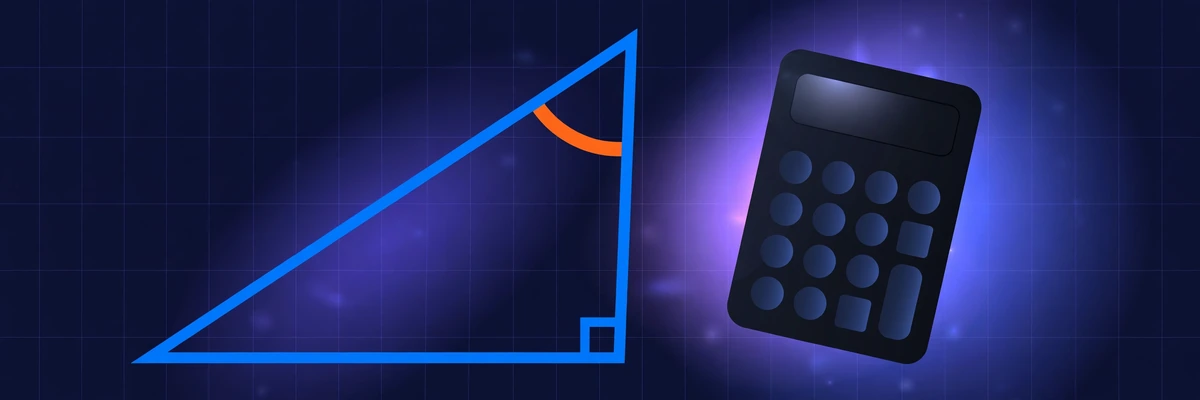
Finding an Unknown Side Using Trigonometric Ratios
Pick the ratio that links the side you know to the side you want. Hypotenuse 10 and angle 30 degrees gives opposite 5. Adjacent 7 and angle 45 degrees gives opposite 7. Adjacent 8, angle 60 degrees, gives hypotenuse 16.
Calculating Unknown Angles
Angles come from inverse functions: arcsin, arccos and arctan. Sine 0.5 means 30 degrees, cosine 0.6 means 53.13 degrees, and tangent 0.75 means 36.87 degrees.
Solving Trigonometry Problems Step by Step
Take the 3-4-5 triangle, angle opposite the side of length 3. Label the sides: opposite 3, adjacent 4, hypotenuse 5. Pick sine: 3 divided by 5 is 0.6, and its inverse sine is 36.87 degrees. I check my hand work against a trigonometry calculator online.
Degrees and Radians in Trigonometry
Degrees and radians measure the same angle in different units: a full turn is 360 degrees, or 2 pi radians.
Difference Between Degrees and Radians
Degrees split a circle into 360 parts, handy for everyday measuring. Radians measure an angle by the arc it cuts off, which is why calculus and physics prefer them.
How to Convert Degrees to Radians?
Multiply degrees by pi over 180. 30 degrees becomes 0.523599 radians, 60 degrees 1.047198, and 90 degrees 1.570796. The other way, 2.5 radians is 143.239 degrees. One radian is about 57.29578 degrees.
How to Convert Decimal Values to Degrees?
A decimal angle hides minutes and seconds. In 36.87 degrees, 0.87 times 60 is 52.2 minutes, so it is about 36 degrees and 52 minutes. 30.5 degrees is 30 degrees and 30 minutes; 0.25 degrees is 15 minutes.
Common Trigonometric Identities and Formulas
Identities stay true for every angle. They let you rewrite one function in terms of another.
Basic Trigonometric Identities
Tangent is sine divided by cosine, so tan(30 degrees) is 0.5 divided by 0.866025, which is 0.57735. Sine and cosecant, cosine and secant, tangent and cotangent are reciprocal pairs.
Pythagorean Trigonometric Identity
Sin squared plus cos squared is 1, for any angle. At 30 degrees it reads 0.25 plus 0.75, which is 1. Two more follow: 1 plus tan squared equals sec squared (1.333333 at 30 degrees), and 1 plus cot squared equals csc squared (4 at 30 degrees).
Common Trigonometric Values and Angles
These five angles cover most school problems.
| Angle | sin | cos | tan |
|---|---|---|---|
| 0 degrees | 0 | 1 | 0 |
| 30 degrees | 0.5 | 0.866025 | 0.57735 |
| 45 degrees | 0.707107 | 0.707107 | 1 |
| 60 degrees | 0.866025 | 0.5 | 1.732051 |
| 90 degrees | 1 | 0 | Undefined |
Real-Life Applications of Trigonometry
Trigonometry leaves the textbook the moment you measure something you cannot reach.
Trigonometry in Engineering and Architecture
A ladder 10 metres long leaning at 60 degrees reaches 8.66 metres up a wall, its foot 5 metres from the wall. That triangle decides if the ladder is safe to climb. A roof that rises 4 metres over a 6 metre run has a pitch of 33.69 degrees, because tan is 4 divided by 6, which is 0.6667.
Finding Heights and Distances Using Trigonometry
Stand 50 metres from a tree, measure the angle to its top as 30 degrees, and the height is 50 times tan(30 degrees), which is 28.87 metres. A 12 metre pole with a 20 metre shadow gives an angle of 30.96 degrees. A river measured from a 40 degree angle across a 25 metre baseline works out to 20.98 metres wide.
Trigonometry in Physics and Navigation
A ball thrown at 40 metres per second at 30 degrees moves sideways at 34.64 and up at 20 metres per second. Bearings and map positions are triangles too, solved by GPS thousands of times a second.
Frequently Asked Questions
What is trigonometry used for?
It measures triangles, heights and distances, and shows up in engineering, physics, navigation and astronomy.
How do you calculate sin, cos, and tan?
Use the ratios: sine is opposite over hypotenuse, cosine adjacent over hypotenuse, tangent opposite over adjacent. Sin(30 degrees) is 0.5.
Is trigonometry difficult to learn?
It feels hard at first. Once SOH-CAH-TOA clicks and you work a few real triangles, it feels like common sense.
Who invented trigonometry?
No single person did. Hipparchus, around 190 to 120 BCE, made the first table of chords and is called the father of trigonometry.
What grade is trigonometry taught in?
Usually ages 13 to 16, Grades 9 to 11, depending on the country. The first ideas appear in geometry.
How do you find the height of a triangle using trigonometry?
Use tangent: height equals base times tan of the angle. 50 metres at 30 degrees gives 28.87 metres.
Can a trigonometry calculator show steps?
Yes. A trigonometry calculator with steps shows the working line by line: 30 degrees becomes 0.523599 radians, and its sine is 0.5.
What is the difference between a scientific calculator and a trigonometry calculator?
A scientific calculator does everything: logarithms, powers, roots and more. The other focuses on trig: values, triangle solving, and steps. For a triangle, the trig calculator is faster.