
Fractions A Complete Guide to Understanding and Using Fractions
A fractions is a number that shows part of a whole. It is written as one number over another, like 3/4. The top number counts the parts you have, and the bottom number tells you how many equal parts make up the whole.
If fractions ever made your stomach drop in a maths lesson, you are in good company. The good news is that nearly every rule comes from one simple idea: equal pieces. Once that idea sits comfortably, simplifying, converting, adding and dividing stop feeling like a pile of separate tricks.
This guide takes you through the topic in the order most learners find easiest, with worked examples you can follow on paper. Every example has been checked by calculation, so you can compare your own working with confidence.
Key takeaways
- A fraction is a numerator over a denominator, and the denominator can never be zero.
- The three main types are proper fractions, improper fractions and mixed numbers.
- To simplify, divide the top and bottom by their greatest common factor.
- To add or subtract, use a common denominator. To multiply, go straight across. To divide, flip the second fraction and multiply.
- The two most common slips are adding denominators and forgetting to flip when dividing.
What Is a Fraction?
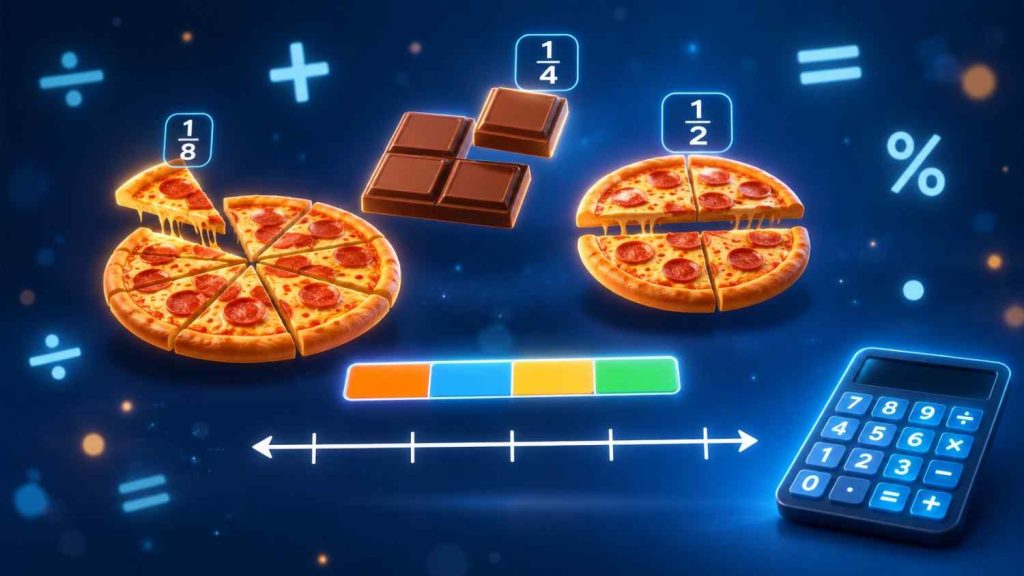
A fraction is a way of writing a number that is not whole. It splits one whole into equal parts and tells you how many of those parts you are talking about. Cut a pizza into 8 equal slices, eat 3, and you have eaten 3/8 of it. The 5 slices left are 5/8.
The word comes from the Latin fractus, meaning “broken”, which is a handy way to remember it: a fraction is a whole that has been broken into pieces. People have worked with them for a very long time. The Rhind Papyrus, an Egyptian maths document from around 1550 BCE, is full of fraction problems.
A fraction is also division written in a different outfit. The fraction 3/4 means 3 ÷ 4, which is why it equals 0.75. Any fraction made of whole numbers, with a denominator that is not zero, is called a rational number.
Parts of a Fraction: Numerator and Denominator
Every fraction has three parts:
- Numerator: the top number. It counts how many parts you have.
- Denominator: the bottom number. It shows how many equal parts the whole is split into.
- Fraction bar (also called the vinculum): the line between them. It means “divided by”.
In 3/4, the numerator is 3 and the denominator is 4. A small memory trick: the denominator sits down at the bottom.
The denominator can never be zero. Splitting something into zero parts makes no sense, so a fraction like 5/0 is undefined. A numerator of zero is fine, though: 0/5 simply equals 0.
Types of Fractions and Their Properties
The three main types are proper fractions, improper fractions and mixed numbers. Knowing which one you are looking at tells you what you can do with it.
Proper Fractions
A proper fraction has a numerator smaller than its denominator, such as 2/5 or 7/8. Its value is always less than 1.
Improper Fractions
An improper fraction has a numerator equal to or larger than its denominator, such as 7/4 or 9/9. Its value is 1 or more. The name is only a label. There is nothing wrong with these fractions, and they are often the easiest form to calculate with.
Mixed Numbers
A mixed number joins a whole number and a proper fraction, like 1 3/4. It means 1 + 3/4, and it equals the improper fraction 7/4.
Other Types Worth Knowing
- Unit fractions have a numerator of 1, such as 1/8.
- Like fractions share a denominator, such as 3/8 and 5/8. Unlike fractions do not, such as 1/3 and 1/4.
- Equivalent fractions look different but have the same value, such as 1/2 and 4/8.
| Type | Example | Decimal | Rule |
| Proper fraction | 2/5 | 0.4 | Numerator smaller than denominator |
| Improper fraction | 7/4 | 1.75 | Numerator equal to or larger than denominator |
| Mixed number | 1 3/4 | 1.75 | Whole number plus a proper fraction |
| Unit fraction | 1/8 | 0.125 | Numerator is 1 |
| Like fractions | 3/8 and 5/8 | 0.375 and 0.625 | Same denominator |
How to Simplify Fractions?
To simplify a fraction, divide both the numerator and the denominator by their greatest common factor (GCF), also called the highest common factor (HCF). The result has the same value but is written in lowest terms, which means the top and bottom share no factor except 1.
Simplifying Fractions Using the Greatest Common Factor (GCF)
- List the factors of the numerator and the denominator.
- Pick the largest factor they share. That is the GCF.
- Divide the numerator and the denominator by it.
Take 30/45. The factors of 30 are 1, 2, 3, 5, 6, 10, 15 and 30. The factors of 45 are 1, 3, 5, 9, 15 and 45. The largest one they share is 15, so 30 ÷ 15 = 2 and 45 ÷ 15 = 3. The answer is 2/3.
For bigger numbers, listing every factor gets slow. The Euclidean algorithm is faster. To simplify 105/252, divide the larger number by the smaller and keep going with the remainders. First, 252 = 2 × 10⁵ + 42. Then 105 = 2 × 42 + 21. Then 42 = 2 × 21 + 0. The last non-zero remainder, 21, is the GCF. Dividing both numbers by 21 gives 5/12.
If you would rather skip the GCF, divide by small numbers one step at a time until nothing divides both. The GCF and LCM Calculator will also find the GCF for you.
Examples of Simplifying Fractions
- 24/36: the GCF is 12, so the answer is 2/3.
- 18/24: the GCF is 6, so the answer is 3/4.
- 48/72: divide by 2 to get 24/36, by 2 again to get 12/18, by 2 again to get 6/9, then by 3 to get 2/3.
- 7/11: both numbers are prime and share no factor, so it is already in lowest terms.
A quick check: if both numbers are even, you can always divide by 2. If the digits of each number add up to a multiple of 3, both numbers divide by 3.
Equivalent Fractions
Equivalent fractions are different fractions that name the same amount, like 1/2, 2/4 and 5/10. They exist because multiplying or dividing the top and bottom by the same non-zero number does not change the value.
How to Find Equivalent Fractions?
- Choose any whole number other than zero.
- Multiply the numerator and the denominator by that number. If both divide evenly, you can divide by it instead.
Why does this work? Multiplying by 3/3 is the same as multiplying by 1, and multiplying by 1 changes nothing. You are only cutting each piece into smaller pieces.
To test whether two fractions are equivalent, cross-multiply. For 3/5 and 12/20, 3 × 20 = 60 and 5 × 12 = 60. The products match, so the fractions are equivalent.
Equivalent Fractions Examples
- 1/2 = 2/4 = 3/6 = 4/8 = 5/10
- 2/3 multiplied top and bottom by 4 gives 8/12
- 15/25 divided top and bottom by 5 gives 3/5
Equivalent fractions are what make adding unlike fractions possible. To add 1/3 and 1/4, both are rewritten as twelfths: 4/12 and 3/12.
How to Convert Fractions?
To get a decimal, divide the top by the bottom. To get a percentage, multiply that decimal by 100. Fractions, decimals and percentages are three ways of writing the same amount, and moving between them is useful in school, in shops and in the kitchen.
How to Convert Fractions to Decimals?
Divide the numerator by the denominator. So 3/4 is 3 ÷ 4 = 0.75, 1/8 is 0.125 and 7/20 is 0.35.
Some fractions give a repeating decimal. 1/3 is 0.333… with the 3 going on forever. Here is a pattern worth knowing: when a fraction is in lowest terms, its decimal stops only if the denominator has no prime factors other than 2 and 5. That is why 3/8 and 7/20 stop, while 1/3 and 1/6 repeat.
How to Convert Decimals to Fractions?
- Write the digits after the decimal point over 1 followed by as many zeros as there are decimal places.
- Simplify the fraction.
For example, 0.75 is 75/100, which simplifies to 3/4. In the same way, 0.125 is 125/1000, which simplifies to 1/8, and 0.6 is 6/10, which simplifies to 3/5.
How to Convert Improper Fractions to Mixed Numbers?
Divide the numerator by the denominator. The whole-number answer is the whole part, the remainder becomes the new numerator, and the denominator stays the same.
Take 17/5. Since 17 ÷ 5 = 3 remainder 2, the mixed number is 3 2/5.
To go back, multiply the whole number by the denominator and add the numerator. For 2 3/4, that is (2 × 4) + 3 = 11, so the improper fraction is 11/4.
How to Convert Fractions to Percentages?
Change the fraction to a decimal, then multiply by 100. So 3/8 = 0.375, which is 37.5%. When the denominator divides into 100, there is a shortcut: 7/20 = 35/100 = 35%.
| Fraction | Decimal | Percentage |
| 1/2 | 0.5 | 50% |
| 1/4 | 0.25 | 25% |
| 3/4 | 0.75 | 75% |
| 1/5 | 0.2 | 20% |
| 1/8 | 0.125 | 12.5% |
| 1/3 | 0.333… | 33.3% (rounded) |
Comparing and Ordering Fractions
To compare two fractions, rewrite them with the same denominator, then compare the numerators. The larger numerator is the larger fraction.
Which is bigger, 3/4 or 5/8? Rewrite 3/4 as 6/8. Since 6/8 is larger than 5/8, 3/4 is larger.
When the numerators match, the smaller denominator means bigger pieces. So 1/3 is larger than 1/5.
To put several fractions in order, use one denominator for all of them. For 1/2, 2/3 and 3/5, the least common denominator (LCD) is 30. They become 15/30, 20/30 and 18/30. In order from smallest to largest, that is 1/2, 3/5, 2/3.
Cross-multiplying is a good shortcut for two fractions with positive denominators. To compare 2/3 and 3/5, work out 2 × 5 = 10 and 3 × 3 = 9. The first product is larger, so 2/3 is the larger fraction.
Fractions on a Number Line
To place a fraction on a number line, split the space between 0 and 1 into as many equal parts as the denominator, then count along by the numerator. The larger fraction always sits further to the right.
To mark 3/4, divide the gap between 0 and 1 into 4 equal steps and count 3 steps from zero. To mark 5/4, keep going past 1: the fifth step lands a quarter beyond 1, so 5/4 = 1 1/4.
A number line from 0 to 2 divided into quarters with 3/4 and 5/4 marked
Basic Fraction Rules and Formulas
Four rules cover almost every fraction calculation. The table gives the formula and one example for each, and the sections below explain how they work.
| Operation | Rule | Example |
| Add | a/b + c/d = (ad + bc) / bd | 1/4 + 1/6 = 10/24 = 5/12 |
| Subtract | a/b – c/d = (ad – bc) / bd | 3/4 – 1/3 = 5/12 |
| Multiply | a/b × c/d = ac / bd | 2/3 × 3/5 = 6/15 = 2/5 |
| Divide | a/b ÷ c/d = ad / bc | 3/4 ÷ 1/2 = 6/4 = 3/2 |
How to Add Fractions?
To add fractions, give them the same denominator, add the numerators and keep the denominator. Simplify the result if you can.
If the denominators match, the sum is quick: 3/8 + 2/8 = 5/8.
If they differ, find a common denominator, usually the least common multiple of the two denominators. For 1/4 + 1/6, the common denominator is 12, so 3/12 + 2/12 = 5/12.
Adding Mixed Numbers
Add the whole numbers, add the fractions, then combine. For 2 1/3 + 1 3/4, the wholes give 3. The fractions give 4/12 + 9/12 = 13/12, which is 1 1/12. Together, 3 + 1 1/12 = 4 1/12.
How to Subtract Fractions?
To subtract fractions, use a common denominator, subtract the numerators and keep the denominator. Simplify if possible.
- 3/4 – 1/3: the common denominator is 12, so 9/12 – 4/12 = 5/12.
- 5/6 – 1/4: the common denominator is 12, so 10/12 – 3/12 = 7/12.
Subtracting Mixed Numbers
The safest route is to change both numbers to improper fractions. For 3 1/4 – 1 1/2, that is 13/4 – 6/4 = 7/4, which is 1 3/4.
How to Multiply Fractions?
To multiply fractions, multiply the numerators, multiply the denominators, then simplify. So 2/3 × 3/5 = 6/15 = 2/5.
A shortcut is to cancel before you multiply. The 3 on top and the 3 on the bottom cancel, which leaves 2/5 straight away.
Multiplying Mixed Numbers
Change them to improper fractions first. For 1 1/2 × 2/3, that is 3/2 × 2/3 = 1. For 1 1/2 × 2 2/3, that is 3/2 × 8/3 = 24/6 = 4.
How to Divide Fractions?
To divide fractions, keep the first fraction, change the division to multiplication, and flip the second fraction. So 3/4 ÷ 1/2 = 3/4 × 2/1 = 6/4 = 3/2, or 1 1/2.
Why does flipping work? Dividing by 1/2 asks how many halves fit into 3/4. Every whole holds two halves, so you multiply by 2. The flipped fraction is called the reciprocal. A whole number has a reciprocal too: write 4 as 4/1 and its reciprocal is 1/4.
Working with Negative Fractions
A negative fraction can carry its minus sign in front, on the top or on the bottom. The values -3/4, (-3)/4 and 3/(-4) are all the same number. Most people write the sign in front or on top. If both parts are negative, the signs cancel: (-3)/(-4) = 3/4.
The sign rules are the same as for whole numbers.
- Adding: -1/2 + 1/3 = -3/6 + 2/6 = -1/6.
- Multiplying: (-2/3) × (3/5) = -6/15 = -2/5.
- Dividing: (-3/4) ÷ (-1/2) = 3/4 × 2/1 = 3/2.
Basic Algebraic Fractions
An algebraic fraction has a letter in the numerator, the denominator or both. Examples are x/3, 2/x and (x + 1)/(x – 2). They follow the same rules as number fractions, with one extra point to keep in mind: the denominator can never equal zero. In (x + 1)/(x – 2), x cannot be 2.
Simplifying Algebraic Fractions
Factor the top and bottom, then cancel the factors they share. Cancel factors only, never separate terms.
Example 1. Simplify 6x²/9x. Divide the numbers by 3 to get 2x²/3x, then cancel one x. The answer is 2x/3, for x not equal to 0.
Example 2. Simplify (x² – 9)/(x + 3). The top factors as (x – 3)(x + 3). Cancel the (x + 3) from top and bottom. The answer is x – 3, for x not equal to -3.
Adding works as it does with numbers. For 2/x + 3/(2x), the common denominator is 2x. That gives 4/(2x) + 3/(2x) = 7/(2x).
Be careful with (x + 4)/4. You cannot cancel the 4s, because the 4 on top is only one term. The correct result is x/4 + 1. For more on letters and equations, see our Algebra page.
Common Mistakes When Working with Fractions
- Adding the denominators. 1/2 + 1/3 is not 2/5. The correct answer is 5/6.
- Forgetting to flip when dividing. Only the second fraction is flipped, and the division becomes multiplication.
- Simplifying only one number. 6/10 becomes 3/5, not 3/10. Whatever you do to the top, do to the bottom.
- Stopping too early. 12/18 becomes 6/9, but 6/9 still simplifies to 2/3.
- Cancelling terms in algebraic fractions. Only factors can be cancelled, not pieces that are added.
- Rounding a repeating decimal too soon. If 1/3 becomes 0.33, then 3 × 0.33 = 0.99, not 1.
- Skipping the sense check. 1/2 + 1/3 has to be more than 1/2. If your answer is 2/5, which is less than 1/2, something went wrong.
Fraction Word Problems
To solve a fraction word problem, work out which operation the wording asks for, then apply the rule. Here are five examples with full working.
- Reading. Sam reads 2/5 of a book on Monday and 1/4 on Tuesday. How much has he read, and how much is left? 2/5 + 1/4 = 8/20 + 5/20 = 13/20 read. Left: 1 – 13/20 = 7/20.
- Ribbon. A ribbon is 3/4 m long and is cut into pieces of 1/8 m. How many pieces? 3/4 ÷ 1/8 = 3/4 × 8 = 6 pieces.
- Sports. 2/3 of 36 students play a sport. How many is that? 36 ÷ 3 = 12, and 12 × 2 = 24 students.
- Baking. A recipe needs 2/3 cup of sugar and you make half the recipe. 2/3 × 1/2 = 1/3 cup.
- Shopping. A coat costs £48 and you pay 3/8 as a deposit. 48 ÷ 8 = 6, and 6 × 3 = £18.
How to Use Fractions in Everyday Maths and Algebra?
Fractions are all around you once you start looking.
- Cooking. A recipe needs 3/4 cup of flour and you double it: 3/4 × 2 = 3/2, which is 1 1/2 cups.
- Sales. Something is one-third off a £60 price. One-third of 60 is 20, so you pay £40.
- Fractions of an amount. To find 3/5 of 40, divide 40 by the denominator, then multiply by the numerator: 40 ÷ 5 = 8, and 8 × 3 = 24.
- Time. 45 minutes is 3/4 of an hour. A fuel gauge at 3/8 means the tank is a bit over a third full.
- Chance. The probability of rolling a 4 on a standard die is 1/6.
- Algebra. The slope of a line is a fraction, rise over run. Equations with fractions are solved with the same balancing steps: for 2x/3 = 8, multiply both sides by 3/2 to get x = 12. Check it: 2 × 12 / 3 = 8.
To check your own working, try the Fraction Calculator or test yourself with the Fractions Quiz. For extra practice, download the Fractions Worksheet (PDF).
Frequently Asked Questions
What is a fraction in simple words?
A fraction shows part of a whole. Imagine a chocolate bar with 10 equal squares. If you eat 4, you have eaten 4/10. The top number counts the pieces you have, and the bottom number tells you how many equal pieces make the whole bar.
What are the three types of fractions?
Fractions come in three main types. A proper fraction, such as 3/5, is smaller than 1. An improper fraction, such as 9/4, is 1 or more. A mixed number, such as 2 1/4, pairs a whole number with a proper fraction. All three can describe the same amounts.
How do you simplify a fraction?
Divide the numerator and denominator by their greatest common factor. For 18/24, the GCF is 6, so the fraction becomes 3/4. When the only shared factor is 1, the fraction is already in lowest terms and cannot be simplified any further.
How do you add fractions with different denominators?
Rewrite both fractions with a common denominator, usually the least common multiple. Then add the numerators and keep the denominator. For 1/4 + 1/6, use twelfths: 3/12 + 2/12 = 5/12. Simplify the answer if possible, and check that it makes sense.
How do you convert a fraction to a decimal?
Divide the numerator by the denominator. For example, 3/4 means 3 ÷ 4, which equals 0.75. Some fractions, such as 1/3, give a repeating decimal (0.333…) that never ends, so you may need to round it or keep the answer in fraction form.
Why do you flip the second fraction when dividing?
Dividing by a number is the same as multiplying by its reciprocal. Asking how many halves fit into 3/4 is the same as asking for 3/4 × 2, which gives 3/2, or 1 1/2. That is why only the second fraction is flipped.
Can a fraction have zero as its denominator?
No. Splitting something into zero equal parts has no meaning, so a fraction such as 5/0 is undefined. A numerator of zero is allowed, though: 0/5 equals 0, because zero parts out of five is nothing at all.
What is the difference between a fraction and a ratio?
A fraction compares a part with the whole, such as 3 girls out of 10 students (3/10). A ratio compares two quantities, such as 3 girls to 7 boys (3:7). A ratio can be written as a fraction, but the meaning changes.