
Compound Interest Calculator – Calculate Your Investment Growth Over Time
I had $1,000 sitting in a savings account that paid almost nothing, and I kept wondering what it would become if I left it alone for ten years. I typed the numbers into the Compound Interest Calculator, and the answer stopped me: $1,628.89. I had put in $1,000, and the interest alone added $628.89. A compounding interest calculator turns a vague hope into a number you can plan around. I have run dozens of plans through the Compound Interest Calculator since then, and I check the Working lines after every run, because I want to see the formula, not just the final number. I have used the CalcSolver tool for every savings plan I make, and this article walks you through the same tool, step by step, with the exact numbers it gave me.
At a glance
- The Compound Interest Calculator on this page takes five inputs: starting amount, annual interest rate, compounding frequency, years, and a monthly contribution if you make one.
- With the defaults, $1,000 at 5% compounded yearly for 10 years becomes $1,628.89, and the interest earned is $628.89.
- Switch the compounding to monthly and the same $1,000 becomes $1,647.01, which is $18.12 more.
- Add $100 a month and the final balance jumps to $17,157.12, with $4,157.12 of interest on $13,000.00 paid in.
- The tool shows its Working, so you can see the formula and the total you put in, and it rounds every money figure to two decimal places.
Compound Interest Calculator
The Compound Interest Calculator asks for five things and nothing else, and that is why I like it. You type in your starting amount, your rate, how often the interest compounds, how many years you will leave the money alone, and a monthly contribution if you make one. Then you press one button, and the answer appears with its Working. I use the CalcSolver tool the same way every time, and the steps below follow the exact labels on the page.
How to Use This Compound Interest Calculator Online?
You do not need an account, a download, or a manual to use this compound interest calculator online. The page opens with the five boxes already filled in with the defaults, so you can press Calculate growth straight away and see what $1,000 does in ten years. I always start from the defaults, because they show me the shape of the answer before I change anything. The Compound Interest Calculator is free, and it works the same way on a phone as it does on a computer.
Step 1: Enter Your Initial Investment
The first box is labelled Starting amount ($), and it already holds 1000. That is the lump sum you put in on day one, and it is the only box the tool insists on. I typed 1000, which was the $1,000 I had sitting in my savings account. If you leave this box empty and press Calculate growth, the tool stops you with one message: Please enter the starting amount. That is the only error message the whole tool has.
Step 2: Add Regular Contributions
The last box is labelled Monthly contribution ($) – optional, and it already holds 0. This is where you add the money you plan to put in every month on top of your starting amount. I typed 100, because $100 a month was what I could spare without feeling it, and the final balance jumped from $1,628.89 to $17,157.12. The tool counts every monthly payment in its total, so with $100 a month for ten years it says you put in $13,000.00 in total. Leave it at 0 if you only want to grow a single lump sum.
Step 3: Enter Your Annual Interest Rate
The second box is labelled Annual interest rate (%), and it already holds 5. This is the yearly rate your money earns, before compounding, and it is the number that does most of the work in the answer. I left it at 5, because that was the rate my savings account quoted. The tool accepts 0 here without any error, and at 0% the answer is simply your starting amount back, $1,000.00, with $0.00 of interest.
Step 4: Choose Your Compounding Frequency
The third field is a dropdown labelled Compounded, and it already shows Yearly. You get two choices, Yearly and Monthly, and that choice decides how often your interest starts earning interest of its own. I left it on Yearly first, because that is the default, and then I switched it to Monthly and watched the same $1,000 grow to $1,647.01 instead of $1,628.89. The tool does not offer daily or quarterly compounding, so if your bank compounds daily, the monthly figure is the closest the tool can show you.
Step 5: Select Your Investment Period
The fourth box is labelled Years, and it already holds 10. This is how long you leave the money alone, and it is the input that rewards patience the most. I set it to 10, because ten years felt far enough away to be real and close enough to plan for. The tool accepts 0 here without any error, and at 0 years the answer is your starting amount back, $1,000.00, with $0.00 of interest.
Calculate Your Future Investment Value
The button is labelled Calculate growth, and one press is all it takes. The Compound Interest Calculator answers with two numbers, Final balance and Interest earned, and then it shows its Working in two lines, so you can see the formula it used and the total you put in. I press it once with the defaults, read the Working, and then change one input at a time, because changing one thing at a time is how you learn what each box actually does.
Compound Interest Calculation Results
The Compound Interest Calculator shows two numbers first, and then it shows its Working, and that order matters to me. The two numbers tell you where you end up, and the Working tells you how you got there, so you can trust the answer instead of just believing it.
Total Future Value of Your Investment
The first number is labelled Final balance, and the Compound Interest Calculator puts it at the top because it is the answer most people came for. With the defaults, the final balance is $1,628.89, which is the $1,000 you started with plus the $628.89 of interest it earned. I read this number as the value of my money on the last day of the period, after every round of compounding has been added.
Initial Investment and Additional Contributions
The second line of the Working says You put in $1,000.00 in total, and that line is the part most people skip, which is a mistake. It tells you how much of the final balance was your own money, so you can see how much the interest did on its own. Add $100 a month and the same line reads $13,000.00, which is your $1,000 starting amount plus 120 monthly payments of $100.
Total Interest Earned
The second number is labelled Interest earned, and with the defaults it is $628.89. That is the money your money made, and it is the whole point of compounding. On the $1,000 default, interest is more than half of the starting amount after ten years. With $100 a month added, the interest earned is $4,157.12, which is real money that arrived without me working an extra hour.
Investment Growth Over Time
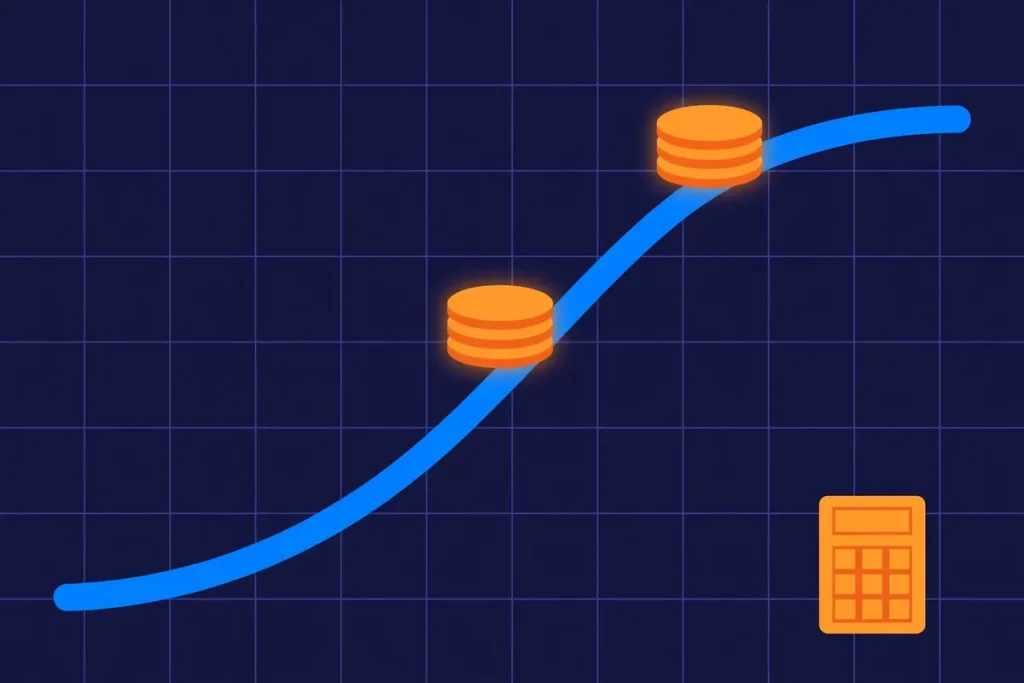
The growth is not a straight line, and that is the part that surprises people the most. In the first year, $1,000 at 5% earns $50.00 of interest, and that feels small. By the tenth year, the balance has grown to $1,551.33 at the start of the year, so the same 5% earns $77.57 in that one year alone. The interest gets bigger every year because each year it is calculated on a larger balance.
Year-by-Year Investment Breakdown
The Compound Interest Calculator does not print a year-by-year table, so I worked this one out by hand from the same formula the tool uses. The table below shows the balance at the end of each year for the defaults, $1,000 at 5% compounded yearly for ten years.
- Year 1: $1,050.00
- Year 2: $1,102.50
- Year 3: $1,157.63
- Year 4: $1,215.51
- Year 5: $1,276.28
- Year 6: $1,340.10
- Year 7: $1,407.10
- Year 8: $1,477.46
- Year 9: $1,551.33
- Year 10: $1,628.89
The first five years add $276.28 in total, and the last five years add $352.61, even though the rate never changes. That is the shape of compounding: slow at first, then faster, because the balance it works on keeps growing.
What Is Compound Interest?
Compound interest is interest earned on interest, and once you see it in numbers, the idea never leaves you. You earn interest on the money you put in, and then you earn interest on that interest too, and the pile grows a little faster every year.
How Compound Interest Works?
The Compound Interest Calculator does the same thing a bank does, only it shows you the steps. Each compounding period, the tool takes your balance, adds the interest for that period, and then uses the new, larger balance for the next period. In the first year, 5% of $1,000 is $50.00, so the balance becomes $1,050.00. In the second year, 5% of $1,050.00 is $52.50, so the balance becomes $1,102.50. The extra $2.50 in the second year is interest on the first year’s interest, and that extra grows every year after.
Compound Interest vs. Simple Interest
Simple interest only ever pays you on the money you first put in, and compound interest pays you on everything you have built up so far. On $1,000 at 5% for ten years, simple interest pays $50.00 a year, every year, for a total of $500.00 and a final balance of $1,500.00. Compound interest earns $628.89 of interest and a final balance of $1,628.89, which is $128.89 more for the same starting amount, the same rate, and the same ten years.
Why Compound Interest Helps Grow Your Savings
Compound interest helps because it turns time into money, and time is the one thing you cannot buy more of. A savings account that pays interest and leaves it in the account is compounding, and every month the interest stays in, the balance it works on is a little larger. The habit that matters most is leaving the interest alone, because the moment you take it out, the compounding stops and the growth goes back to a straight line.
The Power of Compounding Over Time
Time is the strongest input in the whole calculation, and the numbers prove it. At 5% compounded yearly, $1,000 becomes $1,628.89 in ten years, $2,653.30 in twenty years, and $4,321.94 in thirty years. The second ten years add $1,024.41, and the third ten years add $1,668.64, even though the rate never changes. The Rule of 72 is a quick way to feel this: divide 72 by your rate, and you get roughly how many years it takes your money to double. At 5%, that is about 14.4 years, and the exact figure is about 14.2 years.
How to Calculate Compound Interest?
The Compound Interest Calculator uses one formula, and once you can read it, you can check any answer by hand. I check the Working lines the tool shows me, because they print the formula with my own numbers filled in, and that is how I know the answer is mine and not a mystery. The CalcSolver tool does the arithmetic for you, but the formula below is what it is doing, and it is worth knowing.
Compound Interest Formula
The formula is A = P(1 + r/n)^(nt), and the Compound Interest Calculator prints it in its Working as A = P(1 + r ÷ n)nt, with your own rate, compounding count, and years filled in. A is the final amount you end up with, and it is the number labelled Final balance on the page. P is the starting amount you put in, r is the annual interest rate written as a decimal, n is how many times a year the interest compounds, and t is the number of years.
Understanding the Variables in the Formula
Each letter in the formula is one of the boxes on the page, and that is what makes the Compound Interest Calculator easy to use. P is your starting amount, and it is the only box the tool insists on, because without it there is nothing to grow. r is your annual interest rate, written as a decimal, so 5% becomes 0.05. n is the compounding frequency, and it is 1 for yearly and 12 for monthly, which is why the dropdown only offers those two choices. t is the number of years, and it is the only variable that grows the answer faster the longer you wait.
Step-by-Step Compound Interest Calculation
I work the default example out by hand so you can see every step. Start with P = 1000, r = 0.05, n = 1, and t = 10. First, divide the rate by the compounding count: 0.05 ÷ 1 = 0.05. Then add one: 1 + 0.05 = 1.05. Then work out how many times the interest compounds: n × t = 1 × 10 = 10. Then raise 1.05 to the power of 10, which is 1.6288946. Then multiply by the starting amount: 1000 × 1.6288946 = 1628.89. The final balance is $1,628.89, and the interest earned is $1,628.89 − $1,000.00 = $628.89.
Compound Interest Calculation Example
Here is the same example the way the Compound Interest Calculator shows it, with the Working quoted exactly. I typed 1000 for the starting amount, 5 for the rate, left the compounding on Yearly, set the years to 10, and left the monthly contribution at 0. I pressed Calculate growth, and the Compound Interest Calculator answered: Final balance $1,628.89, Interest earned $628.89. Its Working read: 1. Formula: A = P(1 + r ÷ n)nt, with r = 5%, n = 1 (yearly compounding), t = 10 years. 2. You put in $1,000.00 in total, and the interest added is $628.89.
Compound Interest Calculator Monthly – How Monthly Compounding Works?
The Compound Interest Calculator lets you pick Yearly or Monthly in its Compounded dropdown, and that one choice changes the answer by $18.12 on the same $1,000. I check the monthly figure against the yearly one every time I run a plan, because the difference tells me how much the compounding frequency is worth. The CalcSolver tool offers only these two choices, so if your bank compounds daily, the monthly figure is the closest the Compound Interest Calculator can show you.
Monthly Compound Interest Calculation
A compound interest calculator monthly setting means the interest is added twelve times a year instead of once, so your balance starts earning interest on its interest eleven months earlier. With the defaults, the only change is n, which goes from 1 to 12. The formula becomes A = 1000 × (1 + 0.05 ÷ 12)^(12 × 10), and the answer is $1,647.01, with $647.01 of interest. That is $18.12 more than the yearly figure of $1,628.89, for the same $1,000, the same 5%, and the same ten years.
Daily vs. Monthly vs. Quarterly vs. Annual Compounding
The Compound Interest Calculator only offers Yearly and Monthly, so I worked the quarterly and daily figures out by hand from the same formula, using $1,000 at 5% for ten years.
- Annual compounding: $1,628.89, with $628.89 of interest.
- Quarterly compounding: $1,643.62, with $643.62 of interest.
- Monthly compounding: $1,647.01, with $647.01 of interest.
- Daily compounding: $1,648.66, with $648.66 of interest.
The jump from annual to quarterly is $14.73, the jump from quarterly to monthly is $3.39, and the jump from monthly to daily is only $1.65. The gains get smaller each time, because you are splitting the same 5% into more and more pieces. The CalcSolver tool shows you the annual and monthly figures, and the quarterly and daily figures above are my own hand-worked numbers.
How Compounding Frequency Affects Investment Returns?
Compounding frequency affects your returns by deciding how soon your interest starts earning interest of its own, and the effect is real but it shrinks as you compound more often. On $1,000 at 5% for ten years, switching from yearly to monthly adds $18.12, which is worth having, and switching from monthly to daily adds only $1.65, which is barely worth thinking about. The rate and the number of years matter far more than the frequency, and I prove that in the Factors section below, where a 2% higher rate adds $338.26 and ten extra years add $1,024.41.
Choosing the Right Compounding Period
The right compounding period is the one your account actually uses, because a calculation that does not match your account is a calculation you cannot trust. Most savings accounts compound daily or monthly, and the Federal Deposit Insurance Corporation, the FDIC, insures the deposits in those accounts up to $250,000, which is why I keep my emergency money in one. If your account compounds monthly, pick Monthly in the Compound Interest Calculator. If it compounds daily, pick Monthly anyway, because it is the closest choice the tool offers, and the difference from daily is only $1.65 on $1,000 over ten years.
How Additional Contributions Affect Compound Interest?
The Compound Interest Calculator has one more box after the first four, and it is the box that changes the answer the most. The Monthly contribution box lets you add money every month on top of your starting amount, and the tool adds each payment to the total you put in and lets it earn interest too. The CalcSolver tool treats your starting amount and your monthly payments as two piles that grow side by side.
Making Regular Monthly Contributions
I typed 100 into the Monthly contribution box, because $100 a month was what I could spare without feeling it, and the final balance jumped from $1,628.89 to $17,157.12. The Compound Interest Calculator says I put in $13,000.00 in total, which is my $1,000 starting amount plus 120 monthly payments of $100, and the interest earned is $4,157.12. That interest is more than six times the interest on the lump sum alone, and it arrived because every monthly payment started earning interest the month after I made it.
One-Time Investment vs. Regular Deposits
A one-time investment and a regular deposit plan grow in different ways, and the Compound Interest Calculator shows you both. Put $1,000 in once and leave it for ten years at 5% compounded yearly, and you end up with $1,628.89. Put $100 in every month for ten years instead, with no starting amount at all, and you end up with $15,528.23, having paid in $12,000.00 and earned $3,528.23 of interest. Do both, $1,000 at the start plus $100 a month, and you end up with $17,157.12, which is the figure the Compound Interest Calculator gave me.
How Reinvesting Interest Increases Returns?
Reinvesting your interest is what makes compounding happen at all, and taking it out is what stops it. If I take the $50.00 of interest out at the end of every year and spend it, my balance stays at $1,000.00, and after ten years I have $1,500.00 in total, which is my $1,000.00 plus ten lots of $50.00. If I leave the interest in, the balance grows to $1,628.89, which is $128.89 more for the same starting amount, the same rate, and the same ten years. The $128.89 is the interest my interest earned, and it is free money that only exists because I did not touch it.
The Benefits of Starting to Invest Early
Starting early beats starting big, and the numbers are not close. I worked this example out by hand, because the Compound Interest Calculator only goes as far as the years I type in, and I wanted to see a working lifetime. Put $200 a month into a retirement account at 5% from age 25 to age 65, forty years, and you end up with $305,204.03, having paid in $96,000.00 and earned $209,204.03 of interest. Start ten years later, at age 35, and put the same $200 a month in for thirty years, and you end up with $166,451.73, having paid in $72,000.00. The early starter paid in only $24,000.00 more, but ends up with $138,752.30 more, and that gap is pure time. I put my $200 a month into a 401(k) at work, and the same math works in an IRA, because the account does not matter as much as the years you leave it to grow.
Understanding Investment Growth and Annual Percentage Yield (APY)
The Compound Interest Calculator shows a rate, not an APY, and the difference between the two is worth knowing before you compare accounts. The rate is the yearly rate before compounding, and the APY is the effective yearly rate after compounding, so the APY is always a little higher whenever the interest compounds more than once a year. The CalcSolver tool asks for the rate, so if your bank quotes you an APY, you need to know how the two relate, and this section has the exact figures for 5%.
What Is Annual Percentage Yield (APY)?
The Annual Percentage Yield, the APY, is the real yearly return on your money once compounding is taken into account, and it is the number banks use when they advertise a savings account. If a bank says its APY is 5.116%, it means $1,000 left in the account for a year becomes $1,051.16, even though the nominal rate it used to get there was only 5%. The APY exists so you can compare two accounts that compound differently, because a 5% rate compounded monthly beats a 5% rate compounded yearly, and the APY shows you by how much.
Yearly APY and Effective Annual Interest
With yearly compounding, the APY is exactly the same as the rate, because the interest is only added once a year and there is nothing to compound on. At a 5% rate compounded yearly, the APY is 5.000%, and $1,000 left for one year becomes $1,050.00. The effective annual interest is $50.00, which is the simplest case there is, and it is the default the Compound Interest Calculator uses.
Quarterly APY
With quarterly compounding, the interest is added four times a year, so the APY rises a little above the rate. At a 5% rate compounded quarterly, the APY is 5.095%, and $1,000 left for one year becomes $1,050.95. The extra $0.95 over the yearly figure is the interest earned on the interest in the second, third, and fourth quarters, and it is small, but it is real. The Compound Interest Calculator does not offer quarterly compounding, so I worked this figure out by hand from the same formula.
Monthly APY
A compound interest calculator monthly setting means an APY of 5.116% on a 5% rate, and $1,000 left for one year becomes $1,051.16. The extra $1.16 over the yearly figure is the interest earned on the interest across twelve monthly additions, and it is the figure that matches most savings accounts, because most of them compound monthly. I use the monthly APY when I compare my bank account with another one, because it is the number my bank statement actually produces.
Daily APY
With daily compounding, the interest is added every day, so the APY rises a little more, to 5.127% on a 5% rate, and $1,000 left for one year becomes $1,051.27. The extra $0.11 over the monthly figure is tiny, and over ten years the daily figure is only $1.65 ahead of the monthly one, which is why I do not chase daily compounding. The Compound Interest Calculator does not offer daily compounding, so I worked this figure out by hand. The Federal Reserve sets the rates that banks build on, and when it moves, all four of these APYs move with it.
Interest Rate vs. APY
The interest rate is the yearly rate before compounding, and the APY is the effective yearly rate after compounding, and the two are only the same when the interest compounds once a year. A bank that quotes 5% compounded monthly is really paying you 5.116%, and a bank that quotes 5% compounded daily is really paying you 5.127%, even though both call it 5%. The tool asks for the rate, not the APY, so if your bank shows an APY, you need to convert it back to the rate before you type it in, or your answer will be a little too high. The Securities and Exchange Commission, the SEC, runs Investor.gov, and its compound interest calculator is one of the places I checked my own figures against, because a government source is a good place to confirm a number.
Factors That Affect Compound Interest Growth
The Compound Interest Calculator makes the six factors visible, because each one is a box on the page or a choice in the dropdown, and changing one at a time shows you exactly what it is worth. I use the CalcSolver tool to test each factor on its own, and the figures below are all from the same $1,000 starting point, so you can compare them fairly.
Initial Investment Amount
The starting amount is the simplest factor, because the answer grows in direct proportion to it. Put in $1,000 at 5% compounded yearly for ten years and you end up with $1,628.89. Put in $10,000 at the same rate for the same ten years and you end up with $16,288.95, which is exactly ten times as much. Double the starting amount and you double the final balance, and double the interest too, because every dollar earns at the same rate.
Annual Interest Rate
The interest rate is the factor that changes the answer the most for the least extra money, and a small change in the rate makes a large change in the result. On $1,000 for ten years compounded yearly, 5% works out to $1,628.89, 7% works out to $1,967.15, and 10% works out to $2,593.74. The jump from 5% to 7% alone adds $338.26, which is more than half of all the interest the 5% plan earns. A diversified stock portfolio has averaged around 6% a year over the long run, which is the figure I use when I test a market plan in the Compound Interest Calculator, and the S&P 500 is the index I watch to see how that average is doing. I shop for the best rate I can find, and I remember that the Internal Revenue Service, the IRS, taxes the interest I earn as income in the year I earn it, so the rate I keep is a little less than the rate the tool shows.
Investment Duration
Time is the factor that does the most work, and it is the one you cannot buy. On $1,000 at 5% compounded yearly, ten years works out to $1,628.89, twenty years works out to $2,653.30, and thirty years works out to $4,321.94. The second ten years add $1,024.41, and the third ten years add $1,668.64, even though the rate never changes and you never add another dollar. Every extra year adds more than the year before it, because the balance it works on keeps growing, and that is why starting early matters more than starting big.
Compounding Frequency
The compounding frequency is the smallest of the six factors, but the Compound Interest Calculator shows the difference clearly. On $1,000 at 5% for ten years, yearly compounding works out to $1,628.89 and monthly compounding works out to $1,647.01, which is $18.12 more for the same money, the same rate, and the same ten years. Daily compounding would work out to $1,648.66, which is only $1.65 more than monthly, so the gain from compounding more often shrinks fast. I pick the frequency that matches my account and then I stop worrying about it, because the rate and the time are worth far more.
Additional Contributions
Additional contributions are the factor that changes the answer the most in absolute terms, because they add new money on top of the interest. Add $100 a month to the $1,000 default and the final balance jumps from $1,628.89 to $17,157.12, which is more than ten times as much, and the interest earned jumps from $628.89 to $4,157.12. The CalcSolver tool counts every monthly payment in the total you put in, so it says $13,000.00, and the interest is earned on all of it.
Reinvestment of Earnings
Reinvestment is the factor that decides whether compounding happens at all, and it is the only one that costs you nothing. A compounding interest calculator only grows your money if the interest stays in, because the interest has to be there to earn interest of its own. Take the $50.00 of interest out at the end of every year and you end up with $1,500.00 after ten years. Leave it in and you end up with $1,628.89, which is $128.89 more for doing nothing at all.
Frequently Asked Questions
These are the questions I get asked most about the CalcSolver tool, and I answer each one with the numbers the tool itself showed me, so you can check every figure.
How Do I Calculate Compound Interest?
I use the Compound Interest Calculator for this, because it does the arithmetic and shows its Working, but the formula is A = P(1 + r/n)^(nt). Put in your starting amount for P, your rate as a decimal for r, your compounding count for n, and your years for t, and the answer is A, the final balance. For the defaults, that is A = 1000 × (1 + 0.05 ÷ 1)^(1 × 10) = $1,628.89. If you add a monthly contribution, the Compound Interest Calculator adds it separately, as a monthly payment that earns interest of its own, and the Working tells you the total you put in.
Is This Compound Interest Calculator Free to Use?
Yes, this compound interest calculator online is free to use, and you do not need an account, a sign-up, or a download. The page opens with the defaults already filled in, so you can press Calculate growth straight away, and you can run as many plans as you like. I have run dozens of plans through it without paying anything, and the answer is always the same two numbers, Final balance and Interest earned, with the Working underneath.
How Does Monthly Compound Interest Work?
Monthly compound interest works by adding the interest twelve times a year instead of once, so your balance starts earning interest on its interest eleven months earlier. With the defaults, the only change is n, which goes from 1 to 12, and the formula becomes A = 1000 × (1 + 0.05 ÷ 12)^(12 × 10). The answer is $1,647.01, with $647.01 of interest, which is $18.12 more than the yearly figure of $1,628.89. Most savings accounts compound monthly, so this is the figure that usually matches your bank statement.
What Is the Difference Between Compound and Simple Interest?
The difference is what the interest is calculated on. Simple interest is always calculated on your original deposit, so on $1,000 at 5% it is $50.00 every year, and after ten years you have $500.00 of interest and $1,500.00 in total. Compound interest is calculated on your deposit plus all the interest you have earned so far, so the interest itself starts earning interest, and after ten years you have $628.89 of interest and $1,628.89 in total. The $128.89 gap is the interest on the interest, and it grows every year the money stays in.
How Often Should Interest Be Compounded?
Interest should be compounded as often as your account allows, because more often is always better, but the gain gets very small very fast. On $1,000 at 5% for ten years, yearly works out to $1,628.89, quarterly works out to $1,643.62, monthly works out to $1,647.01, and daily works out to $1,648.66. The jump from yearly to monthly is $18.12, and the jump from monthly to daily is only $1.65, so monthly is the practical sweet spot. I pick the frequency that matches my account, and then I focus on the rate and the time, because those two are worth far more than the frequency.
How Much Will $10,000 Grow With Compound Interest?
I ran $10,000 through the Compound Interest Calculator at the same defaults, 5% compounded yearly for ten years, and it becomes $16,288.95, with $6,288.95 of interest. Switch the compounding to monthly and the same $10,000 becomes $16,470.09, with $6,470.09 of interest. Leave it for twenty years instead of ten, at 5% compounded yearly, and it becomes $26,532.98. These figures assume the rate stays at 5% and you add nothing and take nothing out, and the Compound Interest Calculator lets you change any of those assumptions and see the new answer at once.
Does Compound Interest Work for Monthly Deposits?
Yes, compound interest works for monthly deposits, and it works well, because every deposit starts earning interest the month after you make it. I typed 100 into the Monthly contribution box, with the $1,000 starting amount and the same 5% for ten years, and the final balance was $17,157.12, with $4,157.12 of interest on $13,000.00 paid in. Without the starting amount, $100 a month alone for ten years becomes $15,528.23, with $3,528.23 of interest on $12,000.00 paid in.
Why Does Compound Interest Increase Over Time?
Compound interest increases over time because the interest itself starts earning interest, and the balance it works on keeps getting larger. A compounding interest calculator shows the answer growing faster each year, and the defaults prove it: in the first year, $1,000 at 5% earns $50.00 of interest, and in the tenth year, the balance has grown to $1,551.33, so the same 5% earns $77.57 in that one year alone. The rate never changes, but the interest gets bigger every year, because each year it is calculated on a larger balance. That is why the last five years of a ten-year plan add $352.61, while the first five years add only $276.28.