
Area Calculator – Calculate the Area of Different Shapes
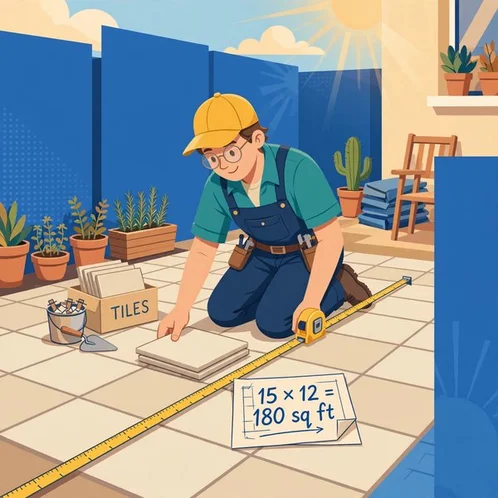
I tiled my back patio last summer, and the Area Calculator showed me the first number I needed: its area. The patio is 15 feet long and 12 feet wide, so 15 × 12 = 180 square feet, and I ordered 198 tiles to cover the 10% I knew I would waste on cuts. That one multiplication decided the whole job, and it is the same multiplication the tool does in a second. I check every room, wall, and garden bed with the Area Calculator now, because guessing the area is how you end up with too few tiles or too much paint.
At a glance:
- The Area Calculator covers three shapes: Rectangle, Circle, and Triangle, with Rectangle selected first.
- The defaults are 5 and 4, so a rectangle is Area = 20 square units and a triangle is 10.
- A circle with radius 5 is 78.54 square units, rounded to two decimals.
- The CalcSolver Area Calculator shows one Working line with the formula it used, and it never asks for units: every answer is in square units.
- Empty inputs show a plain message, zero is zero, and a minus sign means a negative area, so the sign is my job, not the tool’s.
Calculator widget: place the CalcSolver Area Calculator widget here, immediately after the introduction.
Select a Shape and Enter Its Dimensions
The Area Calculator asks for two things before it does anything: a shape and its measurements. Pick the shape first, because the labels on the two boxes change with it, and the second box is not even needed for a circle. That order keeps you from typing a number the CalcSolver Area Calculator will ignore.
Choose Your Geometric Shape
The dropdown holds three shapes: Rectangle, Circle, and Triangle. Rectangle is selected when the page loads, so if you want a circle or a triangle you have to change it first. Everything else in this guide, from a semicircle to a regular polygon, is worked by hand, because the Area Calculator does not offer those shapes at all.
Enter the Required Measurements
The first box takes the length, the radius, or the base, and the second box takes the width or the height. Both boxes start filled in, 5 in the first and 4 in the second, and you can type decimals in either one. Leave the first box empty and the CalcSolver Area Calculator answers “Please enter the first measurement.” Leave the second box empty on a rectangle and it answers “Please enter the width.” On a triangle it answers “Please enter the height.”
Select Your Preferred Measurement Units
There is no units dropdown on the Area Calculator, and no conversion button either. You type plain numbers, and the answer always comes back in “square units”, so the units are your job. If you measure in feet, the answer is square feet; if you measure in meters, the answer is square meters. Mix feet in one box and inches in the other and the answer is wrong, even though the CalcSolver Area Calculator will not warn you.
Calculate and View Your Results
Press Calculate and the answer appears in a blue box: “Area = 20 square units” for the defaults. Under it, a Working box shows the formula the Area Calculator used, “Area = length * width = 5 * 4 = 20”, so you can see the working, not just the answer. The tool only calculates when you press the button; changing a number does nothing until you press it again.
What Is Area in Math?
Area is the amount of flat space inside a shape. When I tiled the patio, the area told me how much surface the tiles had to cover, and nothing else. It is a single number, and it is always measured in square units, because it counts unit squares that fit inside the shape.
Area Definition
Area is the size of a two-dimensional surface, measured in square units. A shape that is 5 units long and 4 units wide holds 20 unit squares, so its area is 20 square units. The definition sounds simple because it is simple: area counts how many unit squares fill a flat shape, edge to edge, with no gaps and no overlaps. Schools teach it early: the Common Core starts area in Grade 3 with unit squares, and the Area Calculator builds on the same idea.
What Does Area Measure?
The area of a shape measures surface, not length and not volume. A rug that is 8 feet by 10 feet covers 80 square feet of floor, and that number tells you how much floor is hidden under the rug. It does not tell you how long the rug is, how thick it is, or how heavy it is. If you need the distance around the rug, that is perimeter; if you need the space inside a box, that is volume.
Area vs Perimeter: What’s the Difference?
Area is the space inside a shape, and perimeter is the distance around it. Take the rectangle from the CalcSolver Area Calculator defaults, 5 by 4: its area is 5 × 4 = 20 square units, and its perimeter is 5 + 4 + 5 + 4 = 18 units. The two numbers answer different questions, and the most common mistake I see is using one when the job needs the other. Fencing needs perimeter; flooring, paint, and tiles need area.
How to Calculate Area of Any Shape?
Every area formula is a shortcut for counting unit squares, and each shape has its own shortcut. A rectangle multiplies length by width, a circle multiplies pi by the radius squared, and a triangle takes half of base times height. Learn the shape first, then pick its formula, then check the units before you trust the answer.
Understanding Area Formulas
A formula is just the counting done in advance. For a rectangle, the rows of unit squares are the width and the squares in each row are the length, so length times width is the total. For a circle, the formula pi times radius squared comes from Archimedes, who proved the area of a circle equals pi times the square of its radius. The formulas look different because the shapes pack their squares differently.
Step-by-Step Area Calculation
First, name the shape and write down its formula. Second, measure the numbers the formula needs, all in the same unit. Third, put the numbers into the formula and work it out, keeping two decimal places where the answer needs them. Fourth, write the answer with square units, and sanity-check it: if the shape is about the size of a door, an answer in the thousands means a measurement went wrong somewhere.
How to Calculate Area Using Different Dimensions?
Different shapes need different measurements, and the Area Calculator’s two boxes change their meaning with the shape. A rectangle needs a length and a width, a circle needs only a radius, and a triangle needs a base and a height. A diameter is not a radius, so a circle with a diameter of 10 has a radius of 5 and an area of 78.54, not the 314.16 you get if you feed the diameter in as the radius. Measure what the formula asks for, not what is easiest to reach.
Area Formulas for Different Geometric Shapes
Seventeen shapes sit under this heading, but the CalcSolver Area Calculator only handles three of them, so each shape below says plainly whether the Area Calculator does it or the working is mine. The formula for every shape is one line, and every example uses small numbers you can check on paper. Where the Area Calculator does the shape, I quote its own Working line; where it does not, I say so and work it out by hand.
Area of a Square
A square is a rectangle with all four sides equal, so its area is side times side. A square with a side of 6 is 6 × 6 = 36 square units. The CalcSolver Area Calculator has no Square option, so I pick Rectangle and type 6 in both boxes, and the tool shows “Area = 36 square units” with the working “Area = length * width = 6 * 6 = 36”. Same shape, same answer, two names for it.
Area of a Rectangle
A rectangle multiplies length by width, and this is the shape the tool opens on. With the defaults, 5 and 4, the Area Calculator shows “Area = 20 square units” and the working “Area = length * width = 5 * 4 = 20”. My bedroom wall is a bigger rectangle, 12 feet wide and 9 feet high, so 12 × 9 = 108 square feet, and that number decided how much paint I bought.
Area of a Triangle
A triangle takes half of base times height, because two identical triangles make one rectangle. With the Area Calculator defaults, base 5 and height 4, the answer is 0.5 × 5 × 4 = 10 square units, and the Area Calculator’s Working line reads “Area = 0.5 * base * height = 0.5 * 5 * 4 = 10”. The half is the part people forget: base times height alone is the rectangle, not the triangle.
Area of a Circle
A circle multiplies pi by the radius squared. With a radius of 5, the Area Calculator shows “Area = 78.54 square units” and its Working line reads “Area = pi * radius * radius = 3.1416 * 5 * 5 = 78.54”. A radius of 7 means pi × 49 = 153.94. One honest detail: the Working line writes 3.1416, but the answer comes from full pi, so a radius of 100 is 31415.93, not the 31416.00 that 3.1416 × 100 × 100 would come to.
Area of a Semicircle
A semicircle is half a circle, so its area is half of pi times the radius squared. With a radius of 5, the full circle is 78.54, so the semicircle is 78.54 ÷ 2 = 39.27 square units. The CalcSolver Area Calculator does not offer a semicircle, so this is my own working, and the only extra step is the division by two at the end.
Area of an Ellipse (Oval)
An ellipse has two radii, a long one and a short one, and its area is pi times the first radius times the second. With radii of 5 and 3, the area is pi × 5 × 3 = 47.12 square units. A circle is just an ellipse whose two radii are equal, which is why the circle formula looks like a special case of this one.
Area of a Trapezoid
A trapezoid has two parallel sides, and its area is half the sum of those sides times the height between them. With parallel sides of 8 and 5 and a height of 4, the area is 0.5 × (8 + 5) × 4 = 0.5 × 13 × 4 = 26 square units. The brackets matter: add the two sides first, then halve, then multiply by the height.
Area of a Parallelogram
A parallelogram multiplies its base by its height, where the height is the straight distance between the two base sides, not the slanted side. With a base of 8 and a height of 5, the area is 8 × 5 = 40 square units. The slanted side is longer than the height, and using it by mistake is the classic error with this shape.
Area of a Rhombus
A rhombus uses its two diagonals: half of the first diagonal times the second. With diagonals of 10 and 6, the area is 0.5 × 10 × 6 = 30 square units. The same formula works for a kite, because both shapes are built from four right triangles around their diagonals.
Area of a Kite
A kite takes half of one diagonal times the other, exactly like a rhombus. With diagonals of 8 and 6, the area is 0.5 × 8 × 6 = 24 square units. The two diagonals cross at right angles, and that right angle is what makes the half appear in the formula.
Area of a Circle Sector
A sector is a slice of a circle, and its area is the fraction of the full circle that its angle covers. With a radius of 6 and an angle of 60 degrees, the slice is 60 ÷ 360 = one sixth of the circle, so the area is (1 ÷ 6) × pi × 36 = 18.85 square units. A 90-degree sector is a quarter of the circle, and a 180-degree sector is a semicircle.
Area of a Pentagon
A regular pentagon, five equal sides, uses the formula one quarter of the square root of 5 times (5 + 2√5), times the side squared. With a side of 5, that is 1.72048 × 25 = 43.01 square units. Nobody works that out by hand twice, so I keep the constant 1.72048 written down and multiply it by the side squared whenever a pentagon appears.
Area of a Hexagon
A regular hexagon is six equilateral triangles joined at the center, so its area is (3√3 ÷ 2) times the side squared. With a side of 4, that is 2.59808 × 16 = 41.57 square units. A hexagon with a side of 1 has an area of 2.60, which is a handy number to remember when you are checking a bigger hexagon.
Area of an Octagon
A regular octagon uses twice (1 + √2) times the side squared. With a side of 3, that is 4.82843 × 9 = 43.46 square units. An octagon with a side of 1 has an area of 4.83, and like the pentagon and hexagon, the shape is one constant times the side squared.
Area of a Regular Polygon
Any regular polygon with n sides of length s has an area of (n × s²) ÷ (4 × tan(pi ÷ n)). With 6 sides of 4, that is 96 ÷ (4 × 0.57735) = 96 ÷ 2.3094 = 41.57 square units, which matches the hexagon above exactly. The formula looks heavy, but it is the same idea for every regular polygon: split it into triangles from the center and add them up.
Area of an Annulus (Ring)
An annulus is the ring between two circles, so its area is the outer circle minus the inner circle: pi times (R² − r²). With an outer radius of 5 and an inner radius of 3, the area is pi × (25 − 9) = pi × 16 = 50.27 square units. A washer, a ring, and a running track all use this shape.
Area of a Quadrilateral
A general quadrilateral has no single formula, so I split it into two triangles along a diagonal and add their areas. Take a four-sided field with a diagonal of 10: the triangle on one side has a height of 6, so its area is 0.5 × 10 × 6 = 30, and the triangle on the other side has a height of 4, so its area is 0.5 × 10 × 4 = 20. Together the field is 30 + 20 = 50 square units, and the same split works for any quadrilateral.
How to Calculate the Area of an Irregular Shape?
An irregular shape has no single area formula, so I never try to force one onto it. The method that works every time is to cut the shape into pieces I do know, work out each piece, and add them together. The area of a shape like this is the sum of its parts, and the cutting lines are mine to choose, so I pick the cut that makes the arithmetic easiest.
Divide an Irregular Shape into Smaller Shapes
Take an L-shaped room that is 10 feet long and 8 feet wide overall, with a 4-by-3-foot corner missing where a cupboard sits. I cut it into two rectangles: the bottom strip, 10 feet by 5 feet, and the top-left block, 6 feet by 3 feet. Both pieces are rectangles, so both use length times width, and the awkward L becomes two easy multiplications.
Add the Individual Areas Together
The bottom strip is 10 × 5 = 50 square feet, and the top-left block is 6 × 3 = 18 square feet, so the room is 50 + 18 = 68 square feet. The same answer comes from subtraction: the full 10-by-8 rectangle is 80 square feet, and the missing 4-by-3 corner is 12, so 80 − 12 = 68. When addition and subtraction agree, I trust the answer.
How to Calculate Area Using Coordinates or a Grid?
On a grid, I count whole squares and estimate the part squares, and for a shape with corners on grid points I use the shoelace method: list the corners in order, multiply across, and halve the difference. A triangle with corners at (0,0), (4,0), and (0,3) is half of 12, which is 6 square units. The area of a shape drawn on graph paper is the same number however you count it, so a second method is the cheapest check there is.
Area Measurement Units and Conversion
Area is always in square units, and the unit you start with decides the unit you finish with. Feet mean square feet, meters mean square meters, and the number means nothing until the unit is attached to it. The Area Calculator never asks for units, so this section is the part the Area Calculator leaves to me.
Square Units Explained
A square unit is the area of a square that is one unit on each side: one foot by one foot is one square foot, and one meter by one meter is one square meter. A rectangle of 5 by 4 holds 20 of those unit squares, which is why its area is 20 square units. Saying “20” without the unit is like giving a price without a currency.
Common Area Units
Small things use square millimeters and square centimeters, rooms use square feet and square meters, and land uses acres and hectares. One square foot is 144 square inches, one square yard is 9 square feet, and one square meter is 10.76391 square feet. I write the unit next to every measurement before I type it in, because a 5 in feet and a 5 in meters are two very different shapes.
Convert Square Feet to Square Meters
One square foot is 0.09290304 square meters, so I multiply the square feet by 0.09290304. My living room is 120 square feet, and 120 × 0.09290304 = 11.14836 square meters. The conversion is exact, and the same factor works whether the room is a cupboard or a warehouse.
Convert Square Meters to Square Feet
One square meter is 10.76391 square feet, so I multiply the square meters by 10.76391. A flat of 50 square meters is 50 × 10.76391 = 538.20 square feet. Going the other way uses division by the same number, and rounding to two decimals keeps the answer readable without losing anything that matters.
Acres, Hectares and Other Land Area Units
One acre is 43,560 square feet, which is 4,046.86 square meters, and one hectare is 10,000 square meters, which is 2.47105 acres. A plot of 5 acres is 5 × 4,046.86 = 20,234.28 square meters. An American football field, with the end zones, is about 1.32 acres, which is the comparison I use when an acre means nothing to the person I am talking to.
How to Use an Area Calculator?
Using the Area Calculator online is a four-step job, and the order matters: shape first, then numbers, then the button. I check the shape dropdown before I type anything, because the labels on the boxes change with the shape and a radius typed as a width means a wrong answer with no warning.
Select the Shape
The dropdown has three choices, and Rectangle is already selected when the page loads. If you want a circle, change it to Circle first, and if you want a triangle, change it to Triangle. The first box then means radius for a circle and base for a triangle, so the shape you pick decides what the numbers mean.
Enter the Required Dimensions
Type the first measurement in the first box and the second in the second box, both in the same unit. The defaults are 5 and 4, and decimals are fine in either box. For a circle, leave the second box alone: the Area Calculator ignores it, and typing a width there changes nothing. An empty first box shows “Please enter the first measurement.” instead of an answer.
Choose Units and Calculate
There is no units setting to choose, so the units are decided before you type: measure in feet and the answer is square feet, measure in meters and it is square meters. Then press Calculate, and the answer appears in the blue box with its Working line underneath. Press it again after any change, because editing a number does not recalculate anything on its own.
Understand Your Results
The answer always reads “Area = [number] square units”, and the Working line shows the formula with your numbers in it. I check the Working line every time, because it shows whether the CalcSolver Area Calculator used the shape I meant: “length * width” means rectangle, “pi * radius * radius” means circle, and “0.5 * base * height” means triangle. If the Working line does not match the shape in your head, the answer belongs to a different shape than the one you wanted.
Practical Applications of Area Calculation
Area shows up in every job where a surface has to be covered, and the Area Calculator online turns each one into a single multiplication. I use it for floors, paint, gardens, and land, and the only difference between those jobs is what the square units are made of.
Calculating Floor and Room Area
My living room is 12 feet by 10 feet, so its area is 120 square feet, and laminate comes in boxes that cover about 20 square feet each, so I need 6 boxes before waste. I add 10% for cuts, which takes the order to 132 square feet, or 7 boxes. Measuring the room took five minutes; the 10% is what stops the last row from running short.
Measuring Land and Property
A plot that is 100 feet by 50 feet has an area of 5,000 square feet, which is 5,000 ÷ 43,560 = 0.11 acres. Real estate agents quote land in acres or hectares, and a buyer who cannot convert square feet into acres cannot compare two plots. The conversion is one division, and it belongs in every property note I write.
Estimating Paint, Flooring and Construction Materials
My bedroom wall is 12 feet wide and 9 feet high, so its area is 108 square feet, and one gallon of paint covers about 350 square feet, so one gallon does the wall with plenty left over. For flooring I work the other way: the room area divided by the coverage per box tells me the boxes, then I add 10% for waste. Paint, tiles, and laminate all buy by the square unit, so the area is the shopping list.
Calculating Garden and Outdoor Areas
A garden bed that is 8 feet by 4 feet has an area of 32 square feet, and soil 3 inches deep over it is 32 × 0.25 = 8 cubic feet, which is 8 ÷ 27 = 0.30 cubic yards. A lawn that is 40 feet by 30 feet is 1,200 square feet, and turf sold by the square yard needs 1,200 ÷ 9 = 133.33 square yards. The bed and the lawn use the same multiplication, and only the material changes.
Measurement Tips to Avoid Common Area Calculation Mistakes
Measure twice, and measure in the same unit both times, because mixing feet and inches is the mistake I see most. A diameter is not a radius, so halve it before it goes into a circle, and the slanted side of a parallelogram is not its height. Round at the end, not in the middle: 3.1416 times 100 times 100 is 31416.00, but the Area Calculator’s full-pi answer for a radius of 100 is 31415.93, and rounding early is how those two drift apart. Add 10% for waste on every material you buy, and check the Working line before you trust the answer.
Frequently Asked Questions
What is the formula for calculating area?
The area formula depends on the shape: a rectangle is length times width, a circle is pi times the radius squared, and a triangle is half of base times height. There is no single formula for all shapes, which is why the first step is always naming the shape.
How do I calculate the area of an irregular shape?
Divide it into smaller shapes you know, work out each area, and add them together. My L-shaped room splits into 10 × 5 = 50 and 6 × 3 = 18, so the room is 68 square feet, and subtracting the missing corner from the full rectangle is the same 68.
What is the difference between area and perimeter?
Area counts the space inside a shape, while perimeter measures the distance around it. A 5-by-4 rectangle has an area of 20 square units and a perimeter of 18 units, so the two numbers answer different questions: flooring needs area, fencing needs perimeter.
What shape has the largest area given the same perimeter?
A circle has the largest area for any fixed perimeter. With a perimeter of 40, a square is 10 × 10 = 100 square units, while a circle has a radius of 40 ÷ (2 × pi) = 6.37 and an area of 127.32 square units.
Which quadrilateral has the largest area?
A square has the largest area of any quadrilateral with the same perimeter. With a perimeter of 40, a square is 100 square units, a 12-by-8 rectangle is 96, and every other quadrilateral is less, because the square is the most compact four-sided shape there is.
How do I calculate the area under a curve?
The area under a curve comes from integration, which adds up infinitely thin slices under the curve. For y = x² from 0 to 2, the integral is x³ ÷ 3, so the area is 8 ÷ 3 = 2.67 square units. The Area Calculator does not do integration, so this one is worked by hand.
Can I calculate area using different measurement units?
Yes, but you have to convert before you calculate, because the CalcSolver Area Calculator takes plain numbers and always answers in square units. Measure everything in one unit first: 120 square feet is 11.14836 square meters, and 50 square meters is 538.20 square feet, and mixing units in one calculation means a wrong answer.
What is the standard unit of area?
The standard unit is the square meter in the SI system, and the square foot is the standard in the United States. Land is usually quoted in acres or hectares instead: one acre is 43,560 square feet, and one hectare is 10,000 square meters.
Conclusion
Area is one multiplication once you know the shape, and the Area Calculator online does it with its Working line shown, so you can check it instead of trusting it blindly. Name the shape, measure in one unit, and read the Working line. That habit saves me on every room, wall, and garden I measure.