
Volume Calculator – Calculate the Volume of Different Shapes
I was standing in the kitchen with a tape measure and a new fish tank. The tank was 24 by 12 by 18 inches, and the filter box said it needed the volume in gallons. I opened the Volume Calculator and typed in my real numbers, and for the first time the tank stopped being a glass box and became a number I could trust. I had never thought about how much water a glass box could hold. That day taught me a Volume Calculator is only useful when I measure in the same unit from start to finish.
At a glance:
- The Volume Calculator turns three measurements into one volume – length times width times height for a box.
- I pick a shape, type its sizes, and press the button.
- With our numbers, the tool shows a 24 by 12 by 18 inch tank as 5,184 cubic inches, which is 22.44 gallons.
- The CalcSolver tool covers a cube, a box, a sphere, a cylinder, and a cone, and I work out a triangular prism and an irregular object by hand.
- I check the units before I trust the answer, because cubic inches and gallons are not the same thing.
How to Use the Online Volume Calculator?
I use the CalcSolver tool in the same order every time, and one volume takes me less than a minute. I pick the shape first, because the boxes change with the shape, and I type the numbers before I press the button.
Select a Shape or Object
The first box I touch is the shape dropdown, and Cube is the default. I pick Cube, Rectangular box, Sphere, Cylinder, or Cone before I type anything, because each shape shows different boxes. There is no triangular prism in the CalcSolver tool’s list, so when I need one I work it out by hand. Switching the shape leaves the old answer on screen until I press the button again.
Enter the Required Measurements
I type the number into each box the shape shows. A cube needs one side, a box needs length, width, and height, a sphere needs one radius, and a cylinder and a cone need a radius and a height. The boxes take decimals, so 2.5 works fine, and the defaults are 5 for the side and the length, 3 for the width and the radius, and 2 for the height. If I leave a box empty and press the button, the CalcSolver tool says “Please enter the side length.” for a cube, or the matching line for the missing box. A minus sign works too, because the tool never checks the sign – a side of -5 shows ‘Volume: -125 cubic units’, and a side of 0 shows ‘Volume: 0 cubic units’, so the sign is my job, not the tool’s.
Choose Your Measurement Units
The CalcSolver tool has no units dropdown, so the unit is my job, not the tool’s. Everything comes back as cubic units, so inches in means cubic inches out, and centimeters in means cubic centimeters out. I use the same unit for every box, because mixing inches and centimeters makes a number that looks right and is wrong. When I need gallons or liters I convert by hand after the tool shows me the cubic number.
Calculate Volume and Understand the Results
I press the button and the Volume Calculator shows one bold line, such as “Volume: 125 cubic units” for a cube with side 5. Under the answer the tool shows a Working line with the formula, such as “Formula: V = a³ = 5³ = 125 cubic units.” I read the formula before I trust the number, because a bare answer tells me nothing about how it was made. A volume calculator with steps earns my trust this way, because I can see the factor and the arithmetic instead of taking a bare number on faith.
What Is Volume and How Do You Calculate It?
Volume is the space inside a three-dimensional object, and I work out volume by multiplying the lengths that define it. A box needs three lengths, a sphere needs one radius, and every answer comes out in cubic units. Area covers a flat surface in square units, volume fills a solid in cubic units, and mixing the two is the most common mistake I see.
Understanding Volume in Geometry
Volume is a measure of three-dimensional space, and I picture it as the number of unit cubes that fit inside a solid. A cube with side 3 holds 27 unit cubes, because 3 times 3 times 3 is 27. The idea stays the same for every shape, and only the formula changes. I teach it to myself as filling, not covering, because covering is area and filling is volume.
Difference Between Area and Volume
Area measures a flat surface in square units, and volume measures a solid in cubic units. A floor is 120 square feet, and the room above it is 960 cubic feet when the ceiling is 8 feet high. The two numbers answer different questions, so I never compare them directly. When a question asks how much paint I need, that is area, and when it asks how much water a tank holds, that is volume.
How to Calculate the Volume of a 3D Object?
I calculate volume by picking the formula for the shape, measuring each length in the same unit, and multiplying them together. A cube needs one side, a box needs three sides, and a sphere needs one radius. The Volume Calculator does the multiplication, and I do the measuring, because a wrong measurement makes a right formula show a wrong answer.
Volume Measurement Units
I measure volume in cubic inches, cubic feet, cubic centimeters, and cubic meters, and I convert to gallons or liters when the job needs it. One cubic foot is 7.48 gallons, one cubic meter is 1,000 liters, and one cubic centimeter is exactly one milliliter. The Volume Calculator always answers in cubic units, so the conversion to gallons or liters is a step I do by hand.
Volume Formulas for Different Shapes
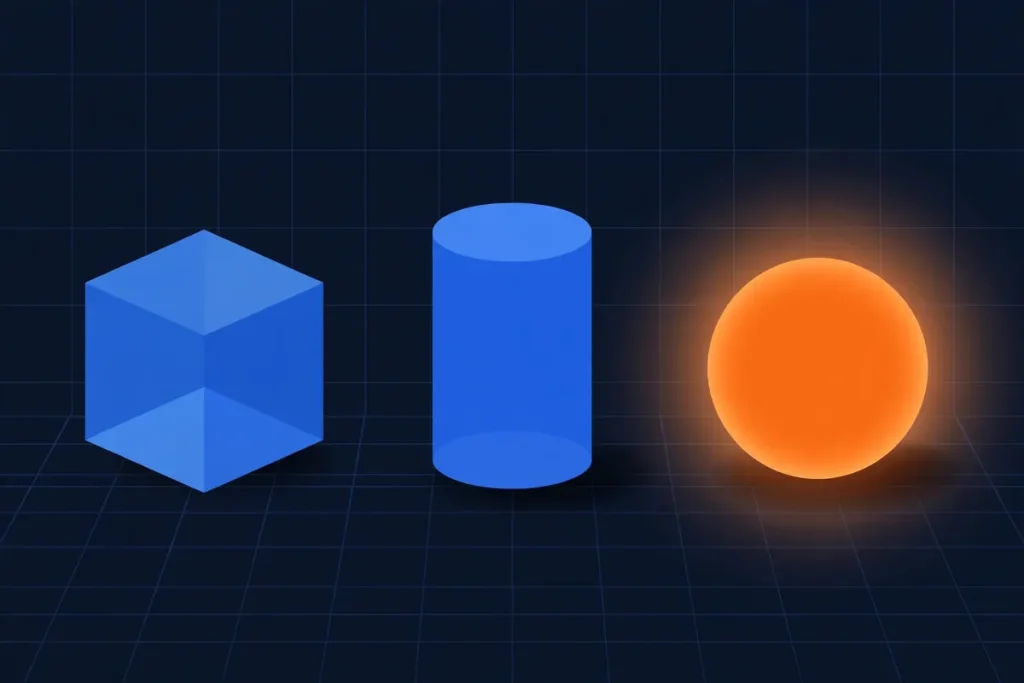
A volume formula calculator is only as good as its formulas, and the CalcSolver tool keeps five of them, one for each shape in its list. I learn each formula as a picture first and a multiplication second, because the picture tells me which lengths to measure. The triangular prism has no button on the tool, so its formula lives in my notes, not on the page.
Volume of a Cube
A cube has six equal square faces, so one side tells me everything. The formula is V = a³, and the Volume Calculator shows “Formula: V = a³ = 5³ = 125 cubic units.” for the default side of 5. A cube with side 3 holds 27 cubic units, and a cube with side 10 holds 1,000. I use a cube when the object is square in every direction, such as a storage box or a die.
Volume of a Box (Rectangular Prism)
A box is a rectangular prism, and its formula is V = l × w × h. The tool shows “Formula: V = l × w × h = 5 × 3 × 2 = 30 cubic units.” for the defaults of 5, 3, and 2. I use a box for rooms, cartons, and tanks, because most things I measure are longer in one direction than the others. A box with 6 by 4 by 2 holds 48 cubic units.
Volume of a Cylinder
A cylinder is a circle stretched up, so its formula is V = π × r² × h. The tool shows “Formula: V = π × r² × h = π × 3² × 2 = 56.55 cubic units.” for a radius of 3 and a height of 2. I use a cylinder for pipes, cans, and flower pots, because the round base is the only new measurement. A cylinder with radius 4 and height 10 holds 502.65 cubic units.
Volume of a Sphere
A sphere is a ball, and its formula is V = 4⁄3 × π × r³. The tool shows “Formula: V = 4⁄3 × π × r³ = 4⁄3 × π × 3³ = 113.1 cubic units.” for a radius of 3. I use a sphere for balls and bubbles, and the radius is the only measurement I need. A sphere with radius 5 holds 523.6 cubic units, and a basketball with radius 12 centimeters holds 7,238.23 cubic centimeters.
Volume of a Cone
A cone is a cylinder that narrows to a point, so its formula is V = 1⁄3 × π × r² × h, exactly one third of the cylinder with the same base and height. The tool shows “Formula: V = 1⁄3 × π × r² × h = 1⁄3 × π × 3² × 2 = 18.85 cubic units.” for a radius of 3 and a height of 2. I use a cone for funnels and ice cream cones, and a cone with radius 4 and height 9 holds 150.8 cubic units.
Volume of a Triangular Prism
A triangular prism is a triangle stretched along a length, and its formula is V = ½ × b × h × L, where b and h are the triangle’s base and height and L is the length. The tool has no triangular prism shape, so this one is a worked example, not a tool result. A prism with a base of 4, a triangle height of 3, and a length of 5 holds 30 cubic units, because half of 4 times 3 is 6, and 6 times 5 is 30.
Volume Formula Examples and Step-by-Step Calculations
I like a volume calculator with steps because the Working line shows the formula, the numbers, and the answer in one place. I run the same three examples every time I teach this to someone, and each one takes less than a minute. The CalcSolver Volume Calculator does the multiplication, and I do the checking, because a formula I can follow is a formula I can trust.
Example of Calculating Cube Volume
I take a cube with side 5 and the tool shows “Volume: 125 cubic units” with the Working line “Formula: V = a³ = 5³ = 125 cubic units.” The step is one multiplication done three times, because 5 times 5 is 25 and 25 times 5 is 125. A cube with side 2.5 holds 15.63 cubic units, because 2.5 times 2.5 times 2.5 is 15.625 and the tool rounds to two decimal places.
Example of Calculating Box Volume
I take a box with length 5, width 3, and height 2, and the tool shows “Volume: 30 cubic units” with the Working line “Formula: V = l × w × h = 5 × 3 × 2 = 30 cubic units.” The step is three multiplications in a row, because 5 times 3 is 15 and 15 times 2 is 30. A box with 6 by 4 by 2 holds 48 cubic units, and I check the answer by multiplying in a different order.
Example of Calculating Cylinder Volume
I take a cylinder with radius 3 and height 2, and the tool shows “Volume: 56.55 cubic units” with the Working line “Formula: V = π × r² × h = π × 3² × 2 = 56.55 cubic units.” The step starts with the circle, because 3 squared is 9, and pi times 9 times 2 is 56.55. I keep the full digits until the last step, because rounding pi to 28.27 first would show 56.54, a hundredth below the tool’s answer.
How to Apply Volume Formulas in Everyday Problems?
I apply a volume formula by naming the shape, measuring each length in the same unit, and letting the tool multiply. A room is a box, a tank is a box or a cylinder, and a ball is a sphere, so the shape tells me the formula. A volume formula calculator checks the arithmetic, and I verify the measurements, because the tool cannot see whether my tape measure slipped. When the answer decides a purchase, I measure twice and calculate once.
Practical Applications of a Volume Calculator
The Volume Calculator earns its place when the number decides what I buy, how much I pour, or how much I order. I use it for water, soil, and sand, because all three are sold by volume and all three punish a wrong guess. The CalcSolver tool shows me the cubic number, and I convert it to gallons, liters, or cubic yards by hand.
Calculating Aquarium Volume in Gallons
My fish tank is 24 inches long, 12 inches wide, and 18 inches tall, so its volume is 5,184 cubic inches, because 24 times 12 times 18 is 5,184. One gallon is 231 cubic inches, so I divide 5,184 by 231 and get 22.44 gallons. I buy the filter for a 25-gallon tank, and I convert to liters too, because 5,184 cubic inches is 84.95 liters.
Measuring Flower Pot Volume
My flower pot is a cylinder with a radius of 15 centimeters and a height of 25 centimeters, so its volume is 17,671.46 cubic centimeters, because pi times 225 times 25 is 17,671.46. One cubic centimeter is one milliliter, so the pot holds 17.67 liters of soil. I buy one 20-liter bag and keep the rest for the next pot, because a pot that looks half full still needs a full bag.
Calculating Materials Volume for Landscaping and Construction
A garden bed is a box, so I measure its length, width, and depth in the same unit and multiply. A bed 10 feet long, 4 feet wide, and 1 foot deep holds 40 cubic feet of soil, because 10 times 4 times 1 is 40. I order by the cubic yard for a big job, and 40 cubic feet is 1.48 cubic yards, because one cubic yard is 27 cubic feet.
Estimating the Amount of Soil, Sand, Gravel, or Mulch Required
I estimate soil, sand, gravel, and mulch the same way, by multiplying length times width times depth and adding a little extra for settling. A bed 3 meters long, 1 meter wide, and 0.3 meters deep needs 0.9 cubic meters, because 3 times 1 times 0.3 is 0.9. That is 1.18 cubic yards, and I order 1.25 to be safe, because a bed always takes more than the math says.
Why Use an Online Volume Calculator?
A volume calculator online saves me the arithmetic, and the Working line saves me the doubt. I use it when the number decides money, because a wrong volume means a wrong order and a wrong order means a second trip. The CalcSolver tool is free, it needs no sign-up, and one calculation takes less than a minute.
Benefits for Students and Professionals
Students use the tool to check homework, and professionals use it to check orders, because both need the same thing, a right number fast. Volume is a Common Core topic in Grade 5, and it returns in GCSE and NCERT geometry, so the same formulas follow a student for years. I check the answer against the formula I know, because a tool I cannot follow is a tool I cannot trust.
Saving Time and Reducing Calculation Errors
I save time because the tool multiplies in a second and shows the Working line, so I never retype a long multiplication by hand. The tool rounds to two decimal places, so 113.097 becomes 113.1 and I read a clean number. I reduce errors by measuring once in one unit and letting the Volume Calculator do the rest, because most volume mistakes are unit mistakes, not multiplication mistakes.
Understanding Volume Results for Real-World Projects
A volume result is only useful when I know its unit, because 30 cubic units could be inches, feet, or meters. I read the Working line first, then I convert the cubic number to gallons, liters, or cubic yards for the order. A volume calculator online is worth keeping open during a project, because the question always comes while my hands are full.
Frequently Asked Questions
What is the formula for calculating volume?
To calculate volume, multiply the lengths that define the shape. A box is length times width times height, a cube is side times side times side, and a sphere is four thirds times pi times radius cubed. A volume formula calculator is only a shortcut for the same multiplication, so I follow the Working line instead of memorizing the letters.
What is the difference between area and volume?
Area measures a flat surface in square units, and volume measures a solid in cubic units. A floor is 120 square feet, and the room above it is 960 cubic feet with an 8-foot ceiling. I never convert one into the other, because they measure different things, and the Volume Calculator on this page calculates volume only.
Which units are used to measure volume?
I measure volume in cubic inches, cubic feet, cubic yards, cubic centimeters, and cubic meters, and I convert to gallons, liters, and milliliters when the job needs it. One cubic meter is 1,000 liters, one cubic foot is 7.48 gallons, and one cubic centimeter is one milliliter. The Volume Calculator answers in cubic units, so I pick the unit that matches the order.
Can a volume calculator be used for construction projects?
Yes, the Volume Calculator works for construction, because a room, a foundation, and a truckload of concrete are all boxes. I measure in feet, multiply length times width times depth, and convert the cubic feet to cubic yards by dividing by 27. A foundation 20 feet by 10 feet by 1 foot is 200 cubic feet, which is 7.41 cubic yards.
Is an online volume calculator suitable for students?
Yes, a volume calculator online is fine for students, because the CalcSolver tool shows the Working line with the formula and the numbers. A student who copies the answer learns nothing, but a student who follows the Working line learns the formula. I use the tool to check homework, and I ask the student to work the multiplication first.
How do I convert cubic units into gallons or liters?
I convert cubic units by hand, because the tool answers in cubic units only. I divide cubic inches by 231 to get gallons, multiply cubic feet by 7.48052 to get gallons, and multiply cubic meters by 1,000 to get liters. A volume calculator with steps shows the cubic answer, and I write the gallon step underneath it in my notebook.
Can I calculate the volume of an irregular object?
Yes, but not with this tool, because it only covers five regular shapes. I use water displacement for an irregular object, by filling a container, marking the level, dropping the object in, and measuring how much the level rises. One milliliter of rise is one cubic centimeter of volume, because one cubic centimeter is exactly one milliliter. Archimedes worked this out more than two thousand years ago, and the method still works.