
Algebra Complete Guide to Algebra Basics, Expressions, Formulas & Calculations
There is a moment almost every student remembers. One day you were adding 4 + 7, and the next day your teacher wrote x + 7 = 11 on the board and asked, “What is x?” If that moment left you staring at the page, you are in very good company. The truth is that algebra looks scarier than it is. Once you learn a handful of words and a few habits, the rest follows a clear pattern. This guide takes you from the first idea to polynomials, factoring, and calculator use, with a solved example at nearly every step. Keep a pencil handy and work along.
What Is Algebra?
Algebra is the branch of mathematics that uses letters and symbols to stand for numbers we do not know yet, so we can write rules and solve problems. In short, you describe a pattern once and then reuse it as many times as you need.
Definition of Algebra
Algebra is the part of mathematics where letters, called variables, take the place of unknown or changing numbers. Arithmetic asks, “What is 4 + 7?” The algebraic version asks, “What number plus 7 makes 11?” and gives you a method that works every time.
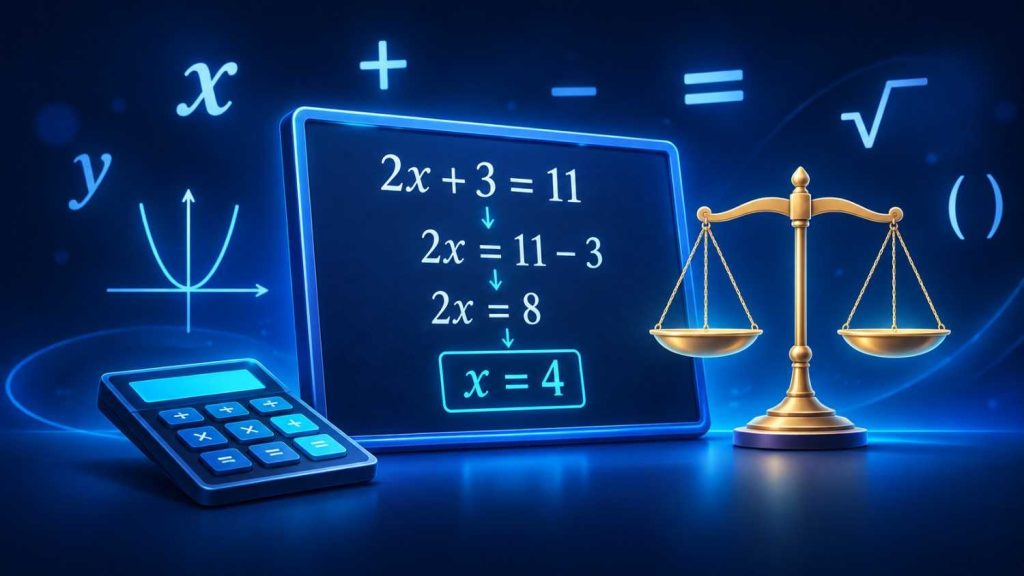
The word comes from the Arabic al-jabr, meaning “restoring” or “balancing.” That is still the heart of it: whatever you do to one side of an equation, you do to the other, so the two sides stay equal.
Why Is Algebra Important in Mathematics?
It is the doorway to nearly every topic that comes after it: geometry formulas, trigonometry, statistics, calculus, and physics all rely on it. Without it, you can solve only one question at a time. With it, you can solve a whole family of questions using a single rule, and that is why schools spend years on the subject.
There is a quieter benefit too. Working through equations trains you to split a problem into what you know and what you do not, write the link between them, and work backward to the answer. That habit helps in budgeting, coding, and everyday decisions.
How Algebra Works with Variables and Numbers?
Think of a variable as an empty box waiting for a number. You use the same addition, subtraction, multiplication, and division you already know, only around the box instead of around a fixed number.
Example: x + 3 = 10. Subtract 3 from both sides and you get x = 7. Plug 7 back in: 7 + 3 = 10. It works, so the answer is right.
Real-Life Applications of Algebra
You use algebraic thinking more often than you realise:
- Shopping: A shirt costs Rs. 1,200 after a 20% discount. What was the original price? Write 0.8x = 1,200, so x = 1,500.
- Saving: You save Rs. 500 a week for a Rs. 12,000 phone. Write 500w = 12,000, so w = 24 weeks.
- Travel: Distance = speed × time. Know two of them and you can find the third.
- Phone or internet plans: Setting two cost equations equal shows the exact point where one plan becomes cheaper.
- Cooking: Scaling a recipe from 4 people to 10 is a simple proportion equation.
Algebra Basics for Beginners
Before formulas, you need the vocabulary. Many students think they are bad at maths when they have simply not met the words yet. Learn the terms below and half the confusion disappears.
Variables, Constants, and Coefficients
In the expression 3x + 5, x is the variable (a value that can change), 5 is the constant (it never changes), and 3 is the coefficient (the number multiplying the variable). Students often mix these up in the first weeks, so say them out loud a few times.
Algebraic Terms and Mathematical Symbols
A term is one piece of an expression, separated from the others by + or − signs. The expression 4x² − 7x + 2 has three terms. Symbols you will meet constantly:
- = equals, ≠ not equal to
- < less than, > greater than, ≤ and ≥ “or equal to”
- ± plus or minus (both answers count)
- √ square root, ≈ approximately equal to
Basic Rules and Properties of Algebra
Four properties do most of the work:
- Commutative: a + b = b + a, and a × b = b × a
- Associative: (a + b) + c = a + (b + c)
- Distributive: a(b + c) = ab + ac
- Identity: a + 0 = a, and a × 1 = a
Example of the distributive property: 3(x + 4) = 3x + 12. Multiply 3 by every term inside the brackets, not just the first one.
Order of Operations in Algebra (PEMDAS)
Work in this order: Parentheses, Exponents, Multiplication and Division (left to right), then Addition and Subtraction (left to right).
Example: 3 + 2 × (4 + 1)². Brackets first: 4 + 1 = 5. Exponent: 5² = 25. Multiply: 2 × 25 = 50. Add: 3 + 50 = 53. Jump a step and you land on a different answer, even if every single calcsolver was correct.
Positive and Negative Numbers
Two numbers with the same sign multiply to a positive; two with different signs multiply to a negative. Subtracting a negative is the same as adding: 5 − (−3) = 8.
One trap catches many students: a minus sign outside brackets flips every sign inside. So −(x − 5) = −x + 5, not −x − 5.
Understanding Algebraic Expressions
What Is an Algebraic Expression?
An algebraic expression is a mix of numbers, variables, and operations with no equals sign, such as 3x + 5. You can simplify it or evaluate it, but you cannot “solve” it, because it does not claim that anything equals anything.
Types of Algebraic Expressions
Expressions are named by how many terms they have:
- Monomial: one term, like 5x
- Binomial: two terms, like x + 3
- Trinomial: three terms, like x² + 5x + 6
- Polynomial: any number of terms, covered in detail below
How to Simplify Algebraic Expressions?
Simplifying means rewriting an expression in its shortest form without changing its value. Remove brackets with the distributive property, then combine like terms.
Example: 2(x + 3) + 4x − 5 = 2x + 6 + 4x − 5 = 6x + 1.
Evaluating Algebraic Expressions
To evaluate, replace each variable with a given number and follow the order of operations.
Example: evaluate 3x² − 2x + 1 when x = 4. Substitute: 3(16) − 8 + 1 = 48 − 8 + 1 = 41. Put the number in brackets when you substitute; it prevents sign mistakes with negatives.
Combining Like Terms
Like terms have the same variable raised to the same power. You can add 5x + 3x = 8x, but you cannot add 5x + 3x², because the powers differ.
Example: 7a + 2b − 3a + b. Group the a-terms (7a − 3a = 4a) and the b-terms (2b + b = 3b). The result is 4a + 3b.
Basic Algebra Formulas You Need to Know
Formulas are shortcuts for patterns that show up again and again. You do not need to memorise a hundred of them. Start with the ones below and you will cover most school problems.
Important Algebraic Identities
- (a + b)² = a² + 2ab + b²
- (a − b)² = a² − 2ab + b²
- a² − b² = (a + b)(a − b)
A handy mental-maths trick: 101² = (100 + 1)² = 10,000 + 200 + 1 = 10,201.
Linear Equation Formulas
For ax + b = 0, the solution is x = −b/a. The equation of a straight line is y = mx + c, where m is the slope and c is the y-intercept.
Example: for 2x + 6 = 0, x = −6/2 = −3.
Exponents and Powers Rules
The core rules are aᵐ × aⁿ = aᵐ⁺ⁿ, aᵐ ÷ aⁿ = aᵐ⁻ⁿ, and (aᵐ)ⁿ = aᵐⁿ. The section on exponents below explains each with examples.
Factoring Formulas
- a² − b² = (a + b)(a − b)
- a³ + b³ = (a + b)(a² − ab + b²)
- a³ − b³ = (a − b)(a² + ab + b²)
- x² + (a + b)x + ab = (x + a)(x + b)
How to Apply Algebra Formulas?
Spot the pattern, match it to a formula, substitute, simplify, and check. Example: factor 49x² − 25. Notice 49x² = (7x)² and 25 = 5². It fits a² − b², so the answer is (7x + 5)(7x − 5). Expand it back to confirm: 49x² − 35x + 35x − 25 = 49x² − 25.
Polynomials Explained
What Is a Polynomial?
A polynomial is an expression made of terms that add or subtract, where each variable has a whole-number power. For example, x² + 3x − 4 is a polynomial. Something like 1/x or √x is not, because the power is negative or fractional.
Types of Polynomials
By number of terms: monomial, binomial, trinomial. By degree: constant (degree 0, like 7), linear (degree 1, like 2x + 1), quadratic (degree 2, like x² − 5x + 6), and cubic (degree 3, like x³ − 8).
Degree of a Polynomial
The degree is the highest power of the variable. In 6x⁴ + 2x² − 9, the highest power is 4, so the degree is 4. The degree tells you how many solutions to expect at most.
Adding and Subtracting Polynomials
Line up like terms and combine them.
Add: (3x² + 2x − 5) + (x² − 4x + 7) = 4x² − 2x + 2.
Subtract: (3x² + 2x − 5) − (x² − 4x + 7). Flip every sign in the second bracket first, so you get 3x² + 2x − 5 − x² + 4x − 7 = 2x² + 6x − 12.
Multiplying Polynomials
Multiply every term in the first bracket by every term in the second (the FOIL method for two binomials: First, Outer, Inner, Last).
Example: (x + 3)(x + 5) = x² + 5x + 3x + 15 = x² + 8x + 15.
Dividing Polynomials
When dividing by a single term, divide each term separately: (6x³ + 9x²) ÷ 3x = 2x² + 3x. When the divisor has two or more terms, use long division or synthetic division, both shown in the section on the remainder theorem.
Factoring Polynomials
What Is Polynomial Factoring?
Factoring means rewriting a polynomial as a product of simpler pieces. It is multiplication in reverse: x² + 5x + 6 becomes (x + 2)(x + 3). It is the key step for solving quadratic equations and simplifying fractions.
Common Factoring Methods
Always try these in order: first pull out the greatest common factor (GCF), then look for an identity such as the difference of squares, then try grouping or trinomial factoring.
Example: 6x² + 9x. The GCF is 3x, so the result is 3x(2x + 3).
Factoring by Grouping
Use grouping for four terms. Split into two pairs, factor each pair, then pull out the shared bracket.
Example: x³ + 3x² + 2x + 6 = x²(x + 3) + 2(x + 3) = (x + 3)(x² + 2).
Factoring Quadratic Expressions
For x² + bx + c, find two numbers that multiply to c and add to b. Example: x² + 7x + 12. The numbers 3 and 4 multiply to 12 and add to 7, so the answer is (x + 3)(x + 4).
When the leading coefficient is not 1, such as 2x² + 7x + 3, multiply 2 × 3 = 6 and look for two numbers that multiply to 6 and add to 7. Those are 1 and 6. Split the middle term: 2x² + x + 6x + 3 = x(2x + 1) + 3(2x + 1) = (2x + 1)(x + 3).
How to Check a Factored Expression?
Multiply the factors back out. If you get the original polynomial, you are correct. Check (x + 3)(x + 4): x² + 4x + 3x + 12 = x² + 7x + 12. It matches.
Algebraic Fractions
What Are Algebraic Fractions?
An algebraic fraction has a polynomial on top, bottom, or both, such as (x + 2)/(x − 3). The bottom can never equal zero, so here x cannot be 3.
Simplifying Algebraic Fractions
Factor the top and bottom, then cancel common factors (never common terms).
Example: (x² − 9)/(x + 3) = (x − 3)(x + 3)/(x + 3) = x − 3, provided x ≠ −3.
Adding and Subtracting Algebraic Fractions
Find a common denominator, rewrite each fraction, then combine the tops.
Example: 1/x + 2/(x + 1) = (x + 1)/(x(x + 1)) + 2x/(x(x + 1)) = (3x + 1)/(x(x + 1)).
Multiplying and Dividing Algebraic Fractions
Multiply tops together and bottoms together. To divide, flip the second fraction and multiply.
Example: (x/3) ÷ (x²/6) = (x/3) × (6/x²) = 6x/3x² = 2/x.
Exponents and Powers in Algebra
What Are Exponents and Powers?
An exponent tells you how many times to multiply a number by itself. In 2⁵, the base is 2 and the exponent is 5, so 2⁵ = 2 × 2 × 2 × 2 × 2 = 32.
Laws of Exponents
- Product law: aᵐ × aⁿ = aᵐ⁺ⁿ (x³ × x² = x⁵)
- Quotient law: aᵐ ÷ aⁿ = aᵐ⁻ⁿ (x⁶ ÷ x² = x⁴)
- Power law: (aᵐ)ⁿ = aᵐⁿ ((x²)³ = x⁶)
- Product to a power: (ab)ⁿ = aⁿbⁿ
Negative and Zero Exponents
Any non-zero number to the power 0 equals 1, so 7⁰ = 1. A negative exponent means “flip it”: a⁻ⁿ = 1/aⁿ, so 2⁻³ = 1/8.
Simplifying Expressions with Exponents
Apply the laws one at a time. Example: (2x³)² × x⁻¹. Square the bracket: 4x⁶ × x⁻¹. Add the powers: 4x⁵. Write each step on its own line; most exponent errors come from doing two laws at once in your head.
Remainder Theorem and Polynomial Division
What Is the Remainder Theorem?
If you divide a polynomial f(x) by (x − a), the remainder equals f(a). It lets you find a remainder without doing any division, and it tells you whether (x − a) is a factor: if f(a) = 0, it is.
How to Apply the Remainder Theorem?
Example: find the remainder when f(x) = x³ − 2x² + x − 5 is divided by (x − 2). Substitute x = 2: 8 − 8 + 2 − 5 = −3. The remainder is −3.
Polynomial Long Division
Work like long division with numbers: divide the leading terms, multiply, subtract, bring down the next term, repeat.
Example: (x² + 5x + 6) ÷ (x + 2). Divide x² by x to get x. Multiply: x² + 2x. Subtract to leave 3x + 6. Divide 3x by x to get 3. Multiply: 3x + 6. Subtract to leave 0. The quotient is x + 3.
Synthetic Division
A faster shortcut when dividing by (x − a). Write only the coefficients and use a.
Example: (2x³ − 3x² + x + 6) ÷ (x − 2), so a = 2. Coefficients: 2, −3, 1, 6. Bring down 2. Multiply by 2 and add: −3 + 4 = 1. Multiply by 2 and add: 1 + 2 = 3. Multiply by 2 and add: 6 + 6 = 12. The quotient is 2x² + x + 3 with remainder 12.
Examples of Polynomial Division
Divide x³ − 4x² + x + 6 by (x − 3) using synthetic division. Coefficients 1, −4, 1, 6 with a = 3: bring down 1; −4 + 3 = −1; 1 − 3 = −2; 6 − 6 = 0. The remainder is 0, so (x − 3) is a factor and the quotient is x² − x − 2.
Factor that too: x² − x − 2 = (x − 2)(x + 1). So the full factorisation is (x − 3)(x − 2)(x + 1).
How to Solve Algebra Problems Step by Step?
The method never changes: simplify each side, move terms with the variable to one side, move numbers to the other, then divide. Always finish by substituting your answer back in.
Solving Basic Algebraic Equations
Example: x + 9 = 14. Subtract 9 from both sides: x = 5. Check: 5 + 9 = 14. Correct.
Solving Linear Equations
Example: 5x + 2 = 2x + 14. Subtract 2x from both sides: 3x + 2 = 14. Subtract 2: 3x = 12. Divide by 3: x = 4. Check: 5(4) + 2 = 22 and 2(4) + 14 = 22.
Solving Quadratic Equations
First try factoring. Example: x² − 5x + 6 = 0 becomes (x − 2)(x − 3) = 0, so x = 2 or x = 3.
When it will not factor, use the quadratic formula: x = (−b ± √(b² − 4ac)) / 2a. For x² + 4x − 1 = 0, a = 1, b = 4, c = −1. The discriminant is 16 + 4 = 20, so x = (−4 ± √20)/2 = −2 ± √5.
Solving Equations with Fractions
Clear the fractions by multiplying everything by the common denominator.
Example: x/3 + x/4 = 7. Multiply by 12: 4x + 3x = 84, so 7x = 84 and x = 12. Check: 12/3 + 12/4 = 4 + 3 = 7.
Worked Algebra Examples with Solutions
Word problem. Ahmed has Rs. 200 more than twice what Bilal has. Together they have Rs. 1,100. How much does Bilal have?
Let b = Bilal’s money. Ahmed has 2b + 200. Then b + 2b + 200 = 1,100, so 3b = 900 and b = 300. Ahmed has 2(300) + 200 = Rs. 800. Check: 300 + 800 = 1,100.
System of equations. Solve x + y = 10 and x − y = 2. Add the two equations: 2x = 12, so x = 6. Then y = 10 − 6 = 4. Check: 6 − 4 = 2.
How to Use an Algebra Calculator?
A calculator is a great checking partner. It is a poor replacement for understanding, because it will never tell you which step comes next.
Entering Algebraic Expressions
Use ^ for powers, / for division, and brackets to protect fractions. Type (x + 1)/(x − 2), not x + 1/x − 2, because the second version means something completely different. Brackets are the single biggest source of wrong calculator answers.
Simplifying Expressions with a Calculator
Enter the expression exactly as written, read the simplified form, then compare it with your hand work. If the two differ, find the first line where they split. That line holds your mistake.
Solving Equations and Checking Answers
Enter the equation to get the solution, or work it by hand first and use the calculator to verify. A quick habit: substitute your answer into the original equation and see whether both sides match.
Using Scientific Functions for Algebra
Functions such as square root, powers, logarithms, and fraction keys handle the arithmetic inside bigger problems. That way an arithmetic slip does not get mistaken for an algebra mistake.
Calculator vs Manual Algebra Solutions
Do it by hand when you are learning, because writing steps builds the skill exams test. Use a calculator to check answers, handle messy decimals, and save time on long problems once the method is clear. The strongest combination is hand first, calculator second.
Common Algebra Mistakes and How to Avoid Them?
Teachers see the same slips year after year. Here are the ones worth watching for:
- Changing only one side. Whatever you do to the left, do to the right.
- Adding unlike terms. 3x + 3x² is not 6x². Only combine terms with the same variable and power.
- Losing a sign when distributing. −2(x − 5) = −2x + 10, not −2x − 10.
- Squaring a sum wrongly. (a + b)² is a² + 2ab + b², not a² + b². The middle term matters.
- Cancelling terms instead of factors. In (x + 4)/4, you cannot cross out the 4s.
- Forgetting to flip an inequality. Multiplying or dividing both sides by a negative reverses the sign: −2x > 6 gives x < −3.
- Skipping the check. Substituting your answer back catches most errors in ten seconds.
Tips for Learning Algebra More Efficiently
- Write every step. Mistakes hide in the steps you do in your head.
- Learn the vocabulary first. Variable, term, coefficient, expression, and equation should feel familiar before you move to formulas.
- Practise a little every day. Twenty minutes daily beats a three-hour session before the exam.
- Redo your errors. Keep a short notebook of mistakes and revisit it weekly.
- Link each topic to a real situation. A discount, a bill, or a trip makes an abstract rule easier to remember.
- Check, then verify. Solve by hand, then confirm with a calculator.
No one masters this subject in a weekend. Small, steady practice works far better than cramming, and each solved problem makes the next one easier.
Frequently Asked Questions
What is algebra in simple words?
It is maths with letters. The letters stand for numbers you do not know yet, which lets you write a rule and find the missing value. If x + 5 = 12, the letter x is the mystery number, and solving the equation shows that it is 7.
What are the basic rules of algebra?
The basic rules are the commutative, associative, distributive, and identity properties, plus the order of operations (PEMDAS). The golden rule of solving: do the same thing to both sides of an equation so it stays balanced.
What are the 4 types of algebra?
The four commonly named branches are pre-algebra (basic rules and operations), elementary algebra (equations and expressions with variables), abstract algebra (structures such as groups and rings), and universal algebra (the study of algebraic structures in general). School courses focus on the first two.
How do beginners start learning algebra?
Start with vocabulary: variable, constant, coefficient, term, expression, equation. Then practise one-step equations, two-step equations, and combining like terms. Move to factoring and quadratics only once those feel automatic.
What are the most important algebra formulas?
The essentials are (a + b)², (a − b)², a² − b², the quadratic formula x = (−b ± √(b² − 4ac)) / 2a, the line equation y = mx + c, and the laws of exponents. Learn these six groups and most school problems become manageable.
How can I solve algebra problems faster?
Speed comes from pattern recognition. Memorise the common identities, factor out the GCF first, clear fractions early, and write neat steps so you never redo work. Timed practice on mixed problems then builds the pace you need for exams.
Can an algebra calculator solve equations?
Yes. A good calculator can simplify expressions, solve linear and quadratic equations, and show many of the steps. Use it to check your own work rather than replace it, because exams usually require you to show the method yourself.