
Times Table: Complete Multiplication Tables and Easy Learning Guide
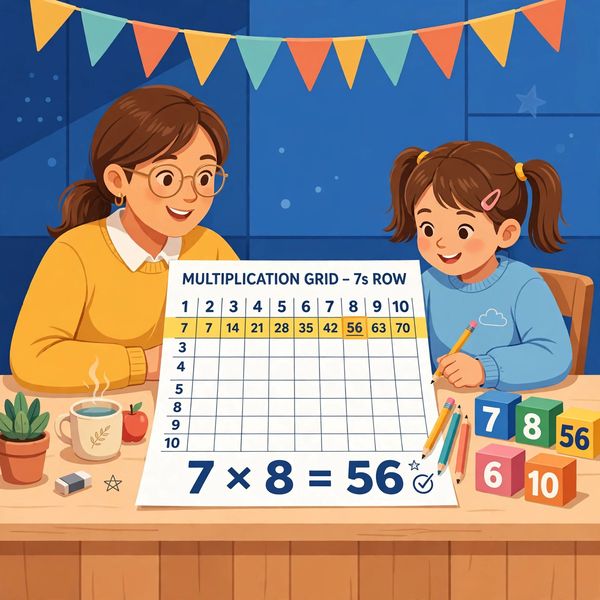
My daughter was stuck on 7 × 8 at the kitchen table last Tuesday, and I watched her count on her fingers until I showed her my favorite Times Table trick: 56 is 7, 8, the numbers 5, 6, 7, 8 in a row.
That night it stopped being her homework and started being our shorthand, because the same 7 × 8 showed up at the supermarket when I worked out 8 packs at $7 each.
I have used the Times Table like that for years, in shops, in the car, and at homework time, and this guide holds everything I actually do with it.
Start with the chart, then the patterns, then the practice, and the hard rows stop feeling hard.
Calculator widget: place the CalcSolver Times Table widget here, immediately after the introduction.
At a glance:
- A Times Table is a grid that shows every multiplication fact for one number, or for all the numbers 1 to 12 at once.
- The CalcSolver tool on this page shows one table at a time: pick a number from 1 to 12 and press Show table.
- The 7s open the page, and its rows run from 1 × 7 = 7 to 12 × 7 = 84.
- Symmetry cuts the work nearly in half: 144 facts on the 1 to 12 grid, but only 78 to learn.
- Five minutes a day beats one long weekly session, and the 2s, 5s, and 10s come first.
What Is a Times Table?
A Times Table is the list of answers you get when you multiply one number by 1, 2, 3, and so on up to 12.
I learned it as a chant in school, and I still hear that chant when I work out a price in my head, because the facts sit in memory instead of needing a fresh calculation every time.
Simple Explanation of Times Tables
Think of one row at a time. The 3s row says 3 × 1 = 3, 3 × 2 = 6, 3 × 3 = 9, and each step adds one more 3. A Multiplication Table is the same idea drawn as a grid, with one number along the top and one down the side, so the answer sits where the row and the column meet.
That grid is why a chart helps: you see the whole pattern at once instead of memorizing 144 separate facts one by one.
How Multiplication Tables Work?
Every fact in the row follows one rule: multiply the table number by 1, then 2, then 3, all the way to 12. In the 4s row that means 4, 8, 12, 16, 20, 24, 28, 32, 36, 40, 44, 48, and the last one, 4 × 12, is 48.
The order never changes, and that is the point. Once you know the 4s row, you know twelve facts, and the same twelve facts show up again as a column when you read the grid the other way.
Understanding Multiplication Through Repeated Addition
Multiplication is fast addition. The fact 4 × 3 means four groups of 3, so 3 + 3 + 3 + 3 = 12, and 3 × 5 means three groups of 5, so 5 + 5 + 5 = 15.
I still use this when a fact slips my mind. If 6 × 4 will not come, I add 4 + 4 + 4 + 4 + 4 + 4 and land on 24, then I know it for next time.
Complete Times Table Chart (1-12)
The Times Table Chart on the CalcSolver page holds every fact from 1 × 1 to 12 × 12 in one grid, and it is the fastest way to find an answer you have not memorized yet.
The chart is 12 rows by 12 columns, so it holds 144 facts, and the diagonal from top left to bottom right holds the twelve square numbers: 1, 4, 9, 16, 25, 36, 49, 64, 81, 100, 121, 144.
Multiplication Tables from 1 to 12
The 1s row is the identity row: 1 × 6 = 6, 1 × 9 = 9, and nothing changes. The 2s row doubles every number, the 5s row ends in 0 or 5, and the 10s row just adds a zero, so 10 × 7 = 70.
The hard rows are the 6s, 7s, 8s, and 9s, and they get easier once the easy rows are solid, because every fact in them has a twin in an easy row: 7 × 8 is the same fact as 8 × 7.
How to Read a Multiplication Table Chart?
Pick the row for the first number and the column for the second number, then look at the box where they meet. For 5 × 7, find the 5 row and the 7 column, and the box says 35. I check the row first, then the column, because reading the wrong row is the mistake I make most often.
Read it the other way for the twin fact: the 7 row and the 5 column meet at the same 35, and that mirror image is the symmetry that halves the learning.
Understanding Rows, Columns, and Multiplication Facts
A row is one number multiplied by 1 to 12, a column is the same idea turned sideways, and a fact is one box: two factors and their product. In 6 × 8 = 48, the factors are 6 and 8 and the product is 48.
The Times Table makes the pattern visible. The 3s row climbs by 3 each step, 3, 6, 9, 12, 15, and the 9s column climbs by 9, 9, 18, 27, 36, 45, so the whole chart is built from simple steps.
How to Use a Times Table with Examples?
The CalcSolver Times Table is one dropdown and one button: pick a number from 1 to 12, press Show table, and the page prints that whole table from × 1 to × 12.
It is the fastest way to check a single row when you are practicing, and the steps line under it spells out the pattern in that row so you can see how each answer grows. The dropdown is labeled ‘Pick a number’, and nothing shows until you press the button: the page first says ‘Pick a number, then press Show table.’ above an empty box.
Simple Multiplication Examples
Start with the 7s, because the Times Table tool opens on 7. The rows run 1 × 7 = 7, 2 × 7 = 14, 3 × 7 = 21, 4 × 7 = 28, 5 × 7 = 35, 6 × 7 = 42, and the last row, 12 × 7, is 84.
Try the 9s next for the digit trick: 9 × 7 = 63, and 6 + 3 = 9. Then 9 × 4 = 36, and 3 + 6 = 9 again, so the digits of every 9s answer add up to 9.
Step-by-Step Multiplication Calculations
Take 8 × 6. First I split it: 8 × 5 = 40, and one more 8 makes 48, so 8 × 6 = 48. Or double it: 4 × 6 = 24, double that, and 8 × 6 = 48 again.
The CalcSolver Times Table does the same idea in its tip line: each row adds 7 to the last answer, so after 7 × 7 = 49 comes 7 × 8 = 56, and the step from one row to the next is always the table number itself.
Times Table Patterns and Properties
Once you see the patterns, the Times Table stops being 144 facts to memorize and starts being a handful of rules that build all of them.
Symmetry is the biggest one, then the square numbers on the diagonal, and then the small tricks inside each row, and this section walks through all three.
Symmetry in a Multiplication Table
Fold the grid along the diagonal from 1 × 1 to 12 × 12 and every number lands on its twin: 4 × 7 = 28 sits exactly on top of 7 × 4 = 28. That is the commutative property, and it means you only learn each fact once.
Count it out: 144 boxes, minus the 12 squares on the diagonal, leaves 132, and those form 66 twin pairs, so the whole grid holds only 78 facts to learn: 66 pairs plus 12 squares.
The Times Table Square and Number Patterns
The diagonal holds the squares: 1 × 1 = 1, 2 × 2 = 4, 3 × 3 = 9, 4 × 4 = 16, 5 × 5 = 25, 6 × 6 = 36, 7 × 7 = 49, 8 × 8 = 64, 9 × 9 = 81, 10 × 10 = 100, 11 × 11 = 121, 12 × 12 = 144.
Each row has its own fingerprint too. The 2s are all even, the 5s end in 0 or 5, the 9s digits add to 9, and the 11s double a digit up to 9: 11 × 6 = 66, 11 × 7 = 77, 11 × 8 = 88, 11 × 9 = 99.
Understanding Factors, Multiples, and Products
In 6 × 8 = 48, the 6 and the 8 are factors, the 48 is the product, and 48 is a multiple of both 6 and 8. The multiples of 6 run 6, 12, 18, 24, 30, 36, 42, 48, and every one of them sits in the 6s row.
Factors work the other way: the factors of 24 are 1, 2, 3, 4, 6, 8, 12, and 24, and each pair in that list is a fact from the Times Table, like 3 × 8 = 24 and 4 × 6 = 24.
Important Properties of Multiplication
Four properties do most of the work. Commutative: 3 × 8 = 8 × 3 = 24. Associative: (2 × 3) × 4 = 2 × (3 × 4) = 24. Identity: 1 × 9 = 9. Distributive: 7 × 6 = 7 × 5 + 7 × 1 = 35 + 7 = 42.
The distributive one is the most useful for hard facts. When 7 × 8 stalls, split it as 7 × 5 + 7 × 3 = 35 + 21 = 56, and the hard fact becomes two easy ones.
How to Learn Times Tables Easily?
The fastest way I know to learn the Times Table is five minutes a day, every day, because the facts need sleep to stick, and one long weekly session never did that for me.
Start with the easy rows, 2s, 10s, and 5s, then add the 3s and 4s, and leave the 6s, 7s, 8s, and 9s for last, when most of their facts are already twins of rows you know.
Skip Counting and Repeated Addition
Skip counting is the row said out loud: the 3s go 3, 6, 9, 12, 15, 18, 21, 24, 27, 30, 33, 36, and saying them while pointing at the row ties the sound to the place on the chart.
Repeated addition is the same idea written out: 4 × 6 means 6 + 6 + 6 + 6 = 24, and once the sum feels obvious, the fact 4 × 6 = 24 replaces it.
Easy Times Table Tricks and Memory Tips
The 9s finger trick never fails me: hold up both hands, fold down finger 3 for 9 × 3, and you see 2 fingers on one side and 7 on the other, which reads as 27. For 9 × 7, fold down finger 7 and you see 6 and 3, which reads as 63.
The 56 = 7, 8 trick is my favorite for the hardest fact: 7 × 8 = 56, and the digits run 5, 6, 7, 8. For the 6s, double the 3s: 6 × 7 is double 3 × 7, so 21 doubled is 42.
Effective Learning Methods for Home and Classroom Practice
At home I use flashcards one row at a time, five minutes before dinner, and I mix in the facts she knows so the hard ones do not all land together. In class, chanting the row together works because the rhythm carries the numbers.
Khan Academy has free multiplication practice with instant feedback, and the Common Core expects fluency within 100 by the end of Grade 3, so the goal is quick recall, not slow working out. In England, Year 4 pupils sit the Multiplication Tables Check: 25 questions, six seconds each, up to 12 × 12.
Common Times Table Mistakes
The mistakes I see most often are not careless slips, they are the same three confusions, and the Times Table itself shows why each one is wrong.
First, adding instead of multiplying. Second, mixing up two facts that look alike. Third, reading the wrong row or column on the chart.
Confusing Multiplication with Addition
A child who sees 3 × 4 and answers 7 has added 3 + 4 instead of multiplying. The fix is the picture: three groups of 4 apples is 12 apples, not 7, and the groups make the operation visible.
The same slip shows up as 5 × 2 = 7. Draw five pairs of dots, count 10, and the answer 10 replaces the 7 for good.
Mixing Up Multiplication Facts
The classic mix-up is 6 × 7 = 42 answered as 48, because 6 × 8 = 48 sits right next to it in memory. The other one is 7 × 8 = 56 answered as 54, borrowed from 6 × 9 = 54.
I fix these by pairing the twins: 6 × 7 = 42 and 6 × 8 = 48 said together, three times, so the two facts stop sharing one slot in memory.
Tips to Improve Multiplication Accuracy
Slow down for the hard rows and say the fact out loud before writing it: 8 × 7 = 56, then check it against a fact you trust, like 8 × 5 = 40 plus 8 × 2 = 16, which is 56 again.
Then test with the CalcSolver chart: find the 8 row and the 7 column and read 56 in the box, and if the box says something else, the row is the first place to look.
Why Are Times Tables Important in Everyday Life?
A Times Table is not schoolwork that stays at school, it is the arithmetic behind prices, recipes, timetables, and measurements, and I use it most days without noticing.
Once the facts are automatic, the bigger math gets easier too, because every long multiplication, division, and fraction starts with a fact from the chart.
Using Multiplication in Shopping and Money Calculations
Six packs at $4 each is 6 × 4 = 24 dollars, and eight notebooks at $3 each is 8 × 3 = 24 dollars, so the same fact answers two different shops. Five tickets at $12 each is 5 × 12 = 60 dollars, and I work that out before I reach the checkout.
Money is where children meet the Times Table first: 4 weeks of $5 allowance is 4 × 5 = 20 dollars, and 7 days of saving $3 is 7 × 3 = 21 dollars.
Times Tables in Measurements and Daily Activities
Three feet is 3 × 12 = 36 inches, four yards is 4 × 3 = 12 feet, and five hours is 5 × 60 = 300 minutes. A dozen eggs is 12, so two dozen is 2 × 12 = 24, and four weeks is 4 × 7 = 28 days.
In the kitchen I scale recipes the same way: a recipe for 4 that serves 8 needs everything doubled, so 3 cups of flour becomes 3 × 2 = 6 cups, and 2 spoons of sugar becomes 2 × 2 = 4 spoons.
How Multiplication Helps with Advanced Mathematics?
Long multiplication starts with single facts: 23 × 4 is 20 × 4 + 3 × 4 = 80 + 12 = 92. Division runs the chart backwards: 56 ÷ 7 = 8 because 7 × 8 = 56, and fractions need the same facts: 6/8 simplifies to 3/4 because both divide by 2.
Algebra leans on it too: 7x = 56 means x = 8, and that step is instant only when 7 × 8 = 56 is already in memory. GCSE math builds on these facts from the first paper onwards, and NCERT Class 3 math introduces multiplication tables the same way.
Times Table Practice and Learning Activities
Practice only works when it is short, daily, and a little bit fun, and the Times Table game on the CalcSolver home page does all three: ten questions, tables 2 to 12, and a score out of 10.
I use the game after the chart, not before it, because the chart teaches the fact and the game tests whether it stuck.
Times Table Practice Questions with Answers
Try these five, then check them below: 6 × 7, 8 × 9, 7 × 7, 12 × 4, and 9 × 5. I check my answers against the chart after each round, and I only move on when all five are right without counting on my fingers.
Answers: 6 × 7 = 42, 8 × 9 = 72, 7 × 7 = 49, 12 × 4 = 48, and 9 × 5 = 45. If one is wrong, practice that row for a day before testing it again.
Printable Multiplication Worksheets
Print one chart and pin it where the homework happens: the 1 to 10 grid first, because its 100 facts end at 10 × 10 = 100, then the 1 to 12 grid when the 11s and 12s are ready. The Times Table Chart on the CalcSolver page comes in four sizes, 1 to 10, 1 to 12, 1 to 15, and 1 to 20, so pick the size that matches the row you are learning. The 1 to 15 grid holds 15 × 15 = 225 facts, and the 1 to 20 grid holds 20 × 20 = 400 facts, and each chart prints best on one page in A4 or US letter size.
A worksheet works best with a timer: ten questions, no chart, then mark them with the chart and circle the misses for tomorrow. Five minutes a day, every day, beats an hour once a week.
Multiplication Tests and Fun Learning Games
The CalcSolver home page game asks ten questions from tables 2 to 12 and keeps your best score, so beating yesterday’s score is the whole game. A deck of cards works too: flip two cards, multiply them, and keep the pair when you answer fast.
In class I have seen bingo with multiplication answers, a race to fill a blank grid, and a chant where the class says the row and the teacher calls the missing number. The format changes, but the rule stays the same: short, daily, and out loud.
Frequently Asked Questions
What Is the Easiest Way to Learn Times Tables?
Start with the 2s, 10s, and 5s, because they have the clearest patterns, then add one row a week and practice it for five minutes a day. Skip counting the row out loud is the easiest first step, and the chart is the backup for any fact that will not stick.
At What Age Should Children Learn Times Tables?
Most children meet the 2s, 5s, and 10s at age 6 or 7, and they are expected to know all the facts up to 12 × 12 by age 8 or 9. In England that lines up with Year 4, when pupils sit the Multiplication Tables Check, and in the United States the Common Core expects fluency within 100 by the end of Grade 3.
Which Times Tables Should You Learn First?
Learn the 2s, 10s, and 5s first, then the 3s and 4s, and save the 6s, 7s, 8s, and 9s for last. By then most of their facts are twins of rows you already know: 7 × 8 is the same fact as 8 × 7, and 6 × 9 is the same as 9 × 6.
How Can I Memorize Times Tables Quickly?
Practice one row for five minutes a day, say each fact out loud, and test yourself without the chart. I check myself with five quick questions each morning, and I only add a new row when the old one is right first time, five days in a row.
Why Is the 9 Times Table Special?
The digits of every 9s answer add up to 9: 9 × 2 = 18 and 1 + 8 = 9, 9 × 7 = 63 and 6 + 3 = 9, 9 × 8 = 72 and 7 + 2 = 9. The finger trick shows the same pattern: fold down one finger and the fingers on each side read out the answer.
What Is the Difference Between a Times Table and a Multiplication Chart?
A table usually means one number’s facts, like the 7s from 1 × 7 to 12 × 7, and a chart usually means the whole 1 to 12 grid with every row at once. The CalcSolver tool shows one table at a time, and the chart below it shows them all, so the two words describe two views of the same facts.
Related Math Topics
The Times Table is the base layer, and these three topics are what it unlocks next. Learn them in this order and the rest of math gets easier.
Multiplication and Division
Division is the chart read backwards: 56 ÷ 7 = 8 because 7 × 8 = 56, and 48 ÷ 6 = 8 because 6 × 8 = 48. Every division fact is a multiplication fact you already know, which is why the tables come first.
Factors and Multiples
The factors of 24 are 1, 2, 3, 4, 6, 8, 12, and 24, and the multiples of 6 are 6, 12, 18, 24, 30, and so on. Factors split a number apart and multiples build it up, and both lists come straight from the rows of the chart.
Multiplication Facts and Number Patterns
Square numbers, even numbers, and the 9s digit pattern are all hiding in the grid, and spotting them is what turns memorizing into understanding. Pythagoras is said to have loved this grid so much that it is still called the Pythagorean table in some countries.